My cat once knocked over our Christmas tree, causing a few of my favourite decorations to break, the rest were saved by the tree’s “paws”. Meanwhile, the cat’s paws were rushing him to another room where the fluffy troublemaker hid under the bed to escape his inevitable punishment. Laughing, I stood the tree back up and collected all the colourful pieces. So many years have passed, and Christmas tree ornaments are still so easily broken. I wondered how they are actually made, so the next day I called “Yolochka” (The Little Christmas Tree), a Christmas tree decoration factory in Klin, and asked them to show me around. Also, I was planning to buy some new tree decorations.
It sounds quite easy to create a design for a Christmas tree ornament. All one has to do is draw a sketch, sculpt the shape, blow it and paint it. However, it is much more complicated. Not every idea can be made in glass. That is why every new toy at the oldest Christmas tree decoration factory in Russia is created by two people — the lead artist and the lead technologist. Initially, the artist comes up with an idea and sketches it. Then the future ornament is sculpted out of plasticine.

At this point the size of the ornament, its height and width, as well as its story are taken into consideration. Then the ornament is sculpted with gypsum and only after that can it be blown out of glass. The shapes for the decorations are crafted by a specialist. The artist paints his “Christmas tree child” himself in three options and then presents the final version to the factory arts council. The council members debate the future toys. There are also members of the finance department among the participants, who often bring the carried-away artists down to earth, taking the cost into account. The marketing department joins in as well, determining whether the product is interesting to customers. Guessing what they wish for is the hardest task. After the creation is approved at the factory, it has to undergo two more trials: The Moscow artists’ council and then the federal one. It is up to them whether the ornament is going to appear on the market or not. If the creation is approved, it is given a code and its technical characteristics are recorded. Only after that can the decoration be produced.

Every ball, every shape at the factory is blown by a real person, not a machine. That is quite rare in the 21st century. Every glass blower is given a certain set of activities. Some blow spheres, some are responsible for shapes. In fact, there are blowers who are better at creating rabbits, or mushrooms. Speaking about squirrels, snowflakes, huts — the glass blowers create thousands of these each month. There is a common joke at the factory that if someone is missing at the workplace, the rabbits will disappear as well. The reason for such a narrow specialisation in “teddy bears and huts” is obvious as the techniques are radically different from each other and re-qualifying means acquiring all the skills from scratch, getting their hand in. In this case, a mouth.
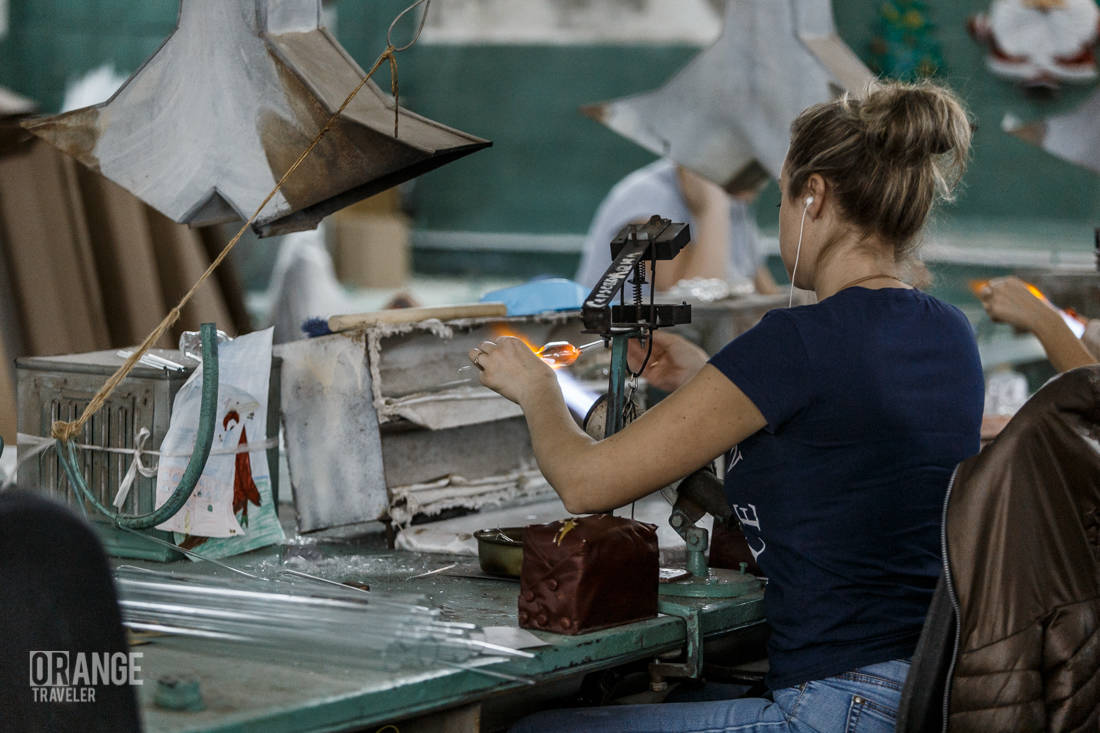
It is dark in the glass blowing section so that both the fire and the object are more visible; headphones are used for noise reduction. All the workers listen to music or podcasts while working. The daily plan for each glass blower depends on the production orders, their size and the factory plans. On average, about 240 spheres are blown per shift, and those are just the ones that passed quality control and were not broken during the process.

The number of large spheres or complicated shapes with a multiple-stage blowing system produced per day is much smaller. It all depends on the complexity. It is a difficult job to blow a large sphere. Try blowing a flawless bubble, without any dents or stretches. Measure the air volume and the force of your exhalation. Now imagine you are working with hot glass. I was watching one of the ladies at work, blowing the large spheres; during this time none of the balls exploded or crashed; there was not even the slightest glass clinking sound.


It will, for sure. The glass and the ornaments can break at every step. Anything can happen since it is all handmade. It is totally normal that the glass breaks, so this cost is included in the production expenses. The glass itself is a complex material. There is internal stress inside the sphere, and if you don’t notice it and don’t take it to the furnace one more time after blowing, it will probably explode just like a bubble. The inspectors check all the Christmas decorations for micro-cracks at every production step. Anything that seems doubtful is considered defective. The checks are mostly done visually but the flaws are sometimes inspected using a special device, especially for those ornaments that are about to be painted in a very artistic way.


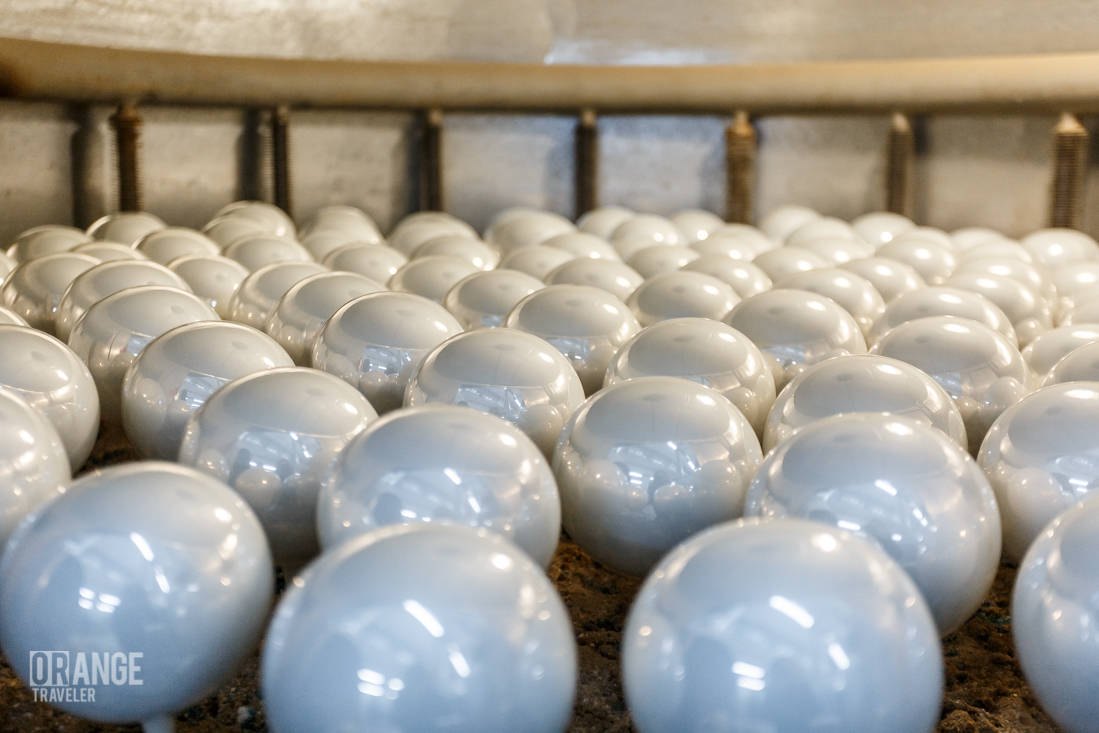
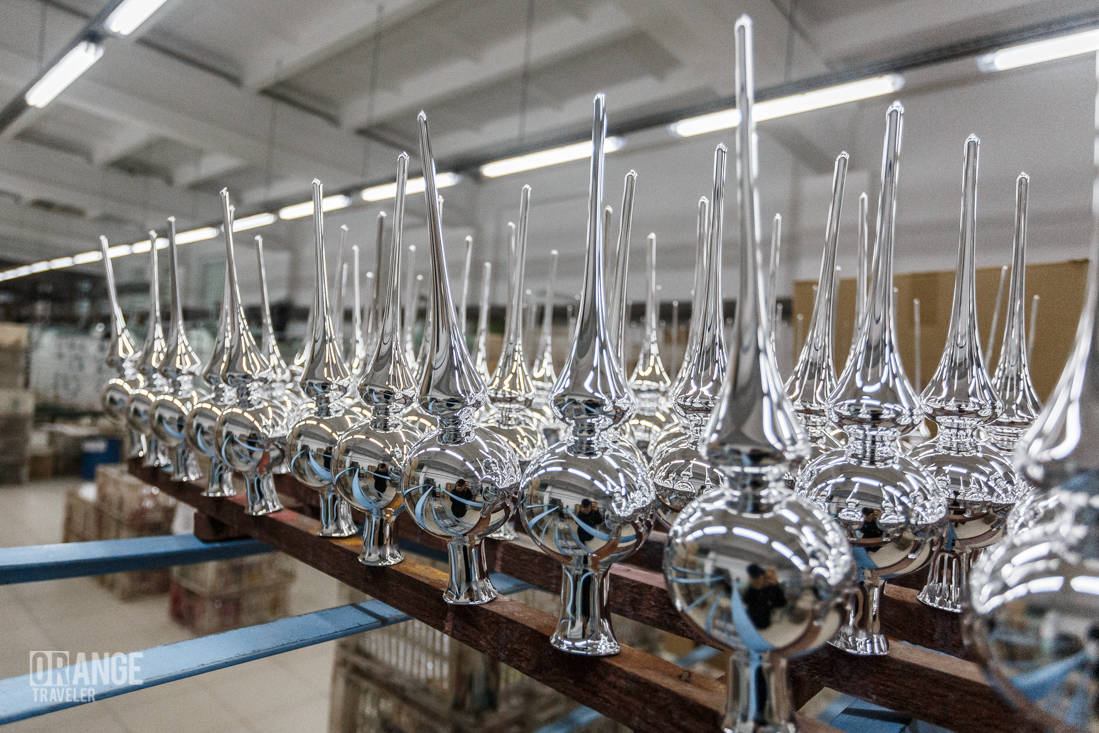
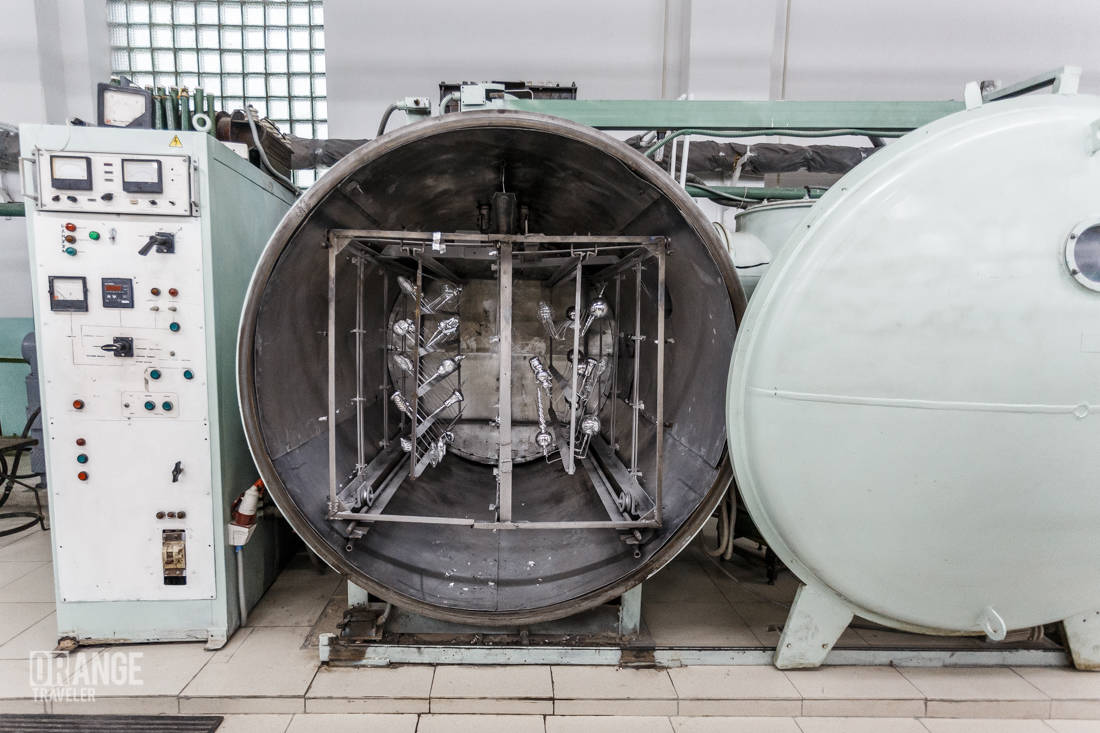
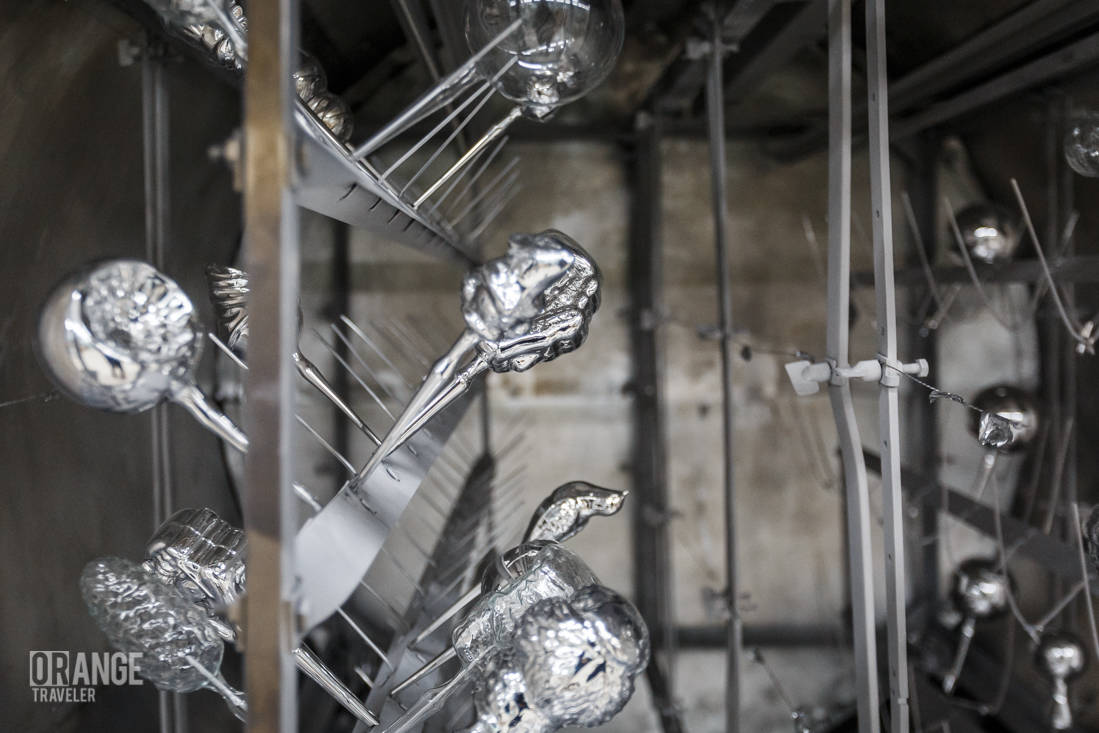
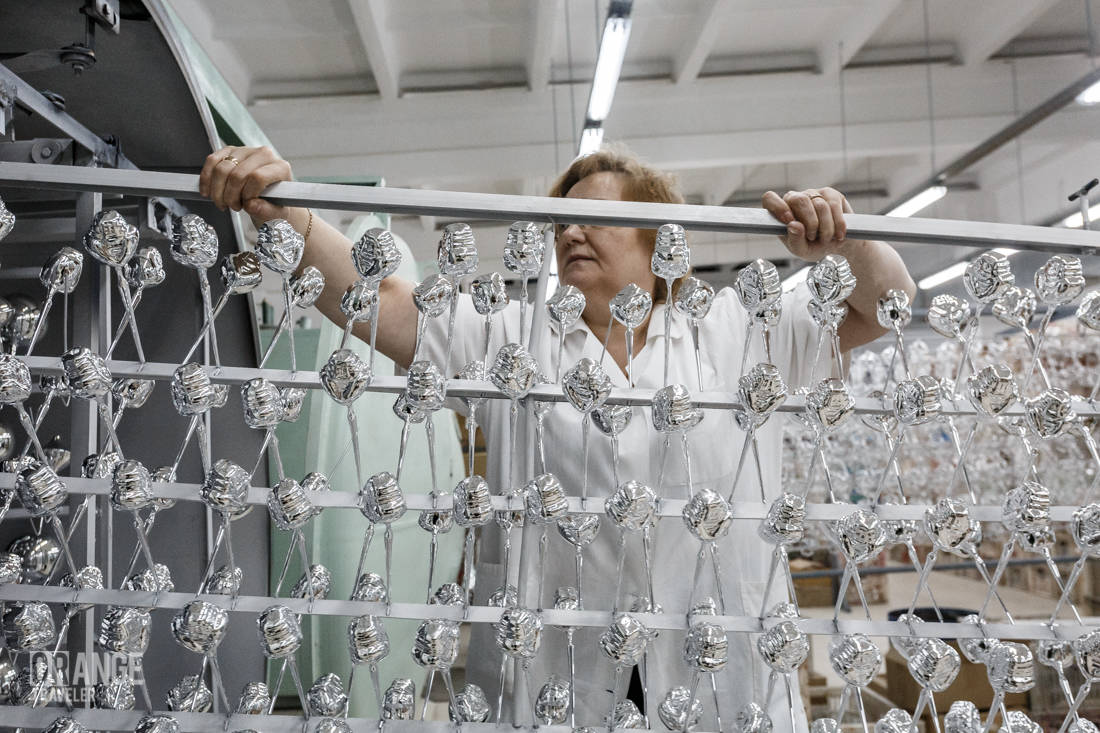
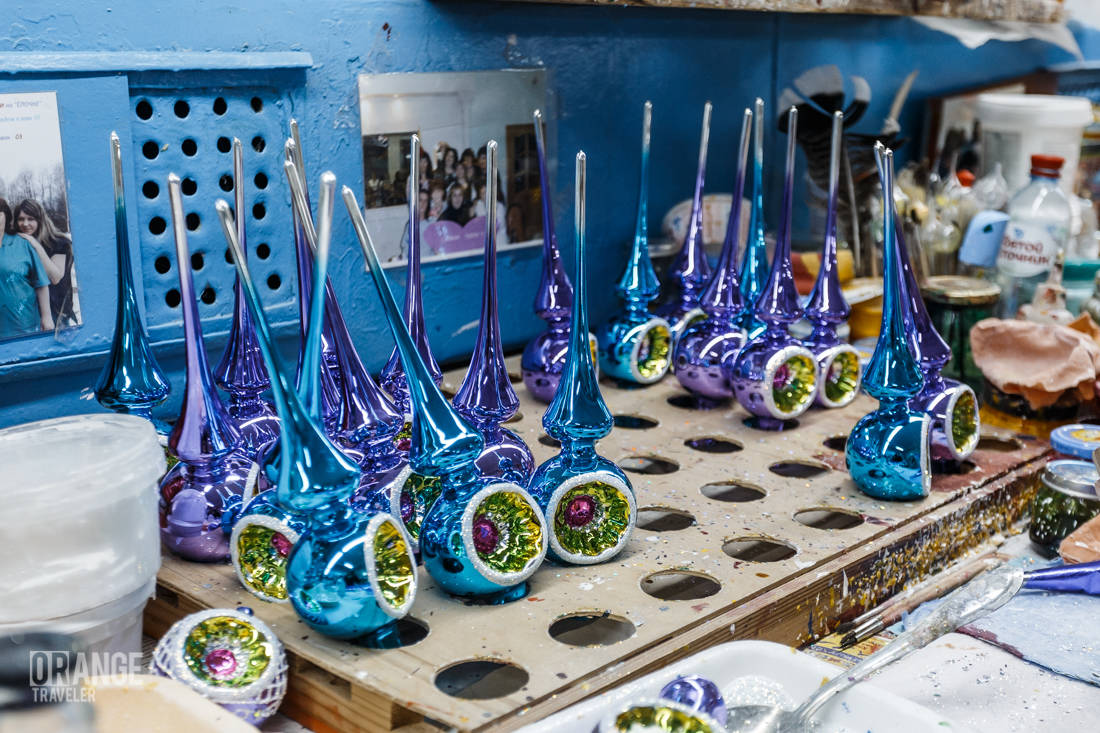
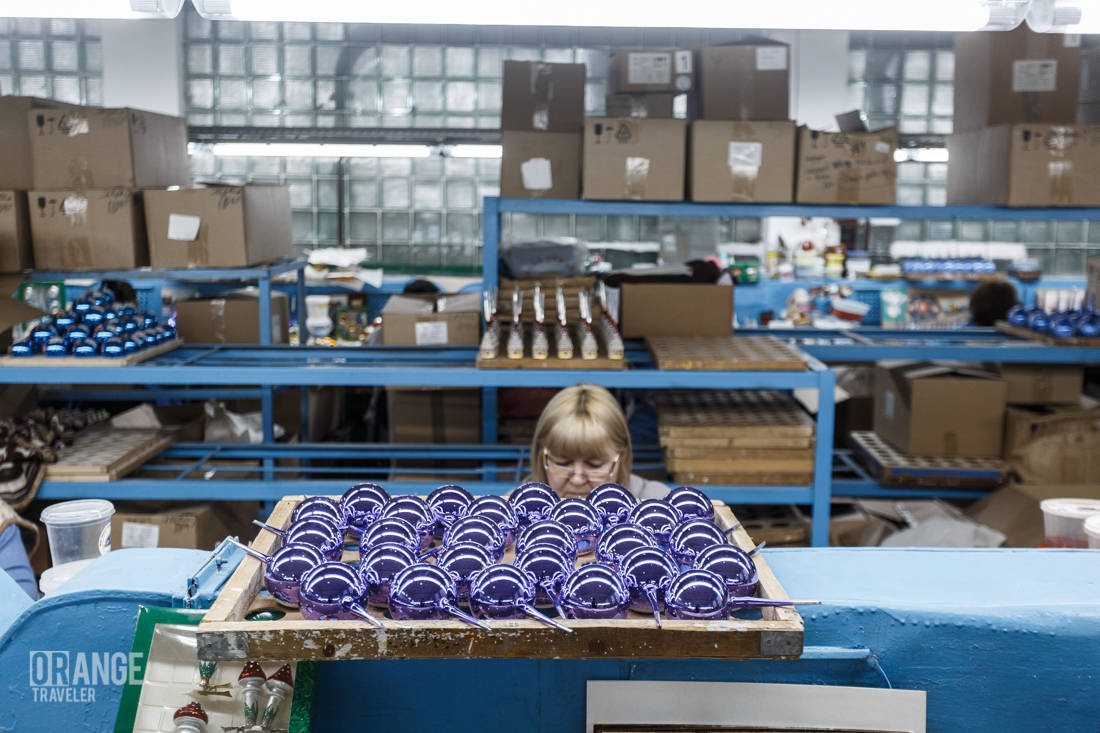
Most of the ornaments, called blanks at this stage, are coated with an extra-thin aluminium layer. This is how they get their Christmassy silver glitter. Moreover, this coating contributes to a smoother paint application, allowing it to last longer and not spread about. The process is called metallisation. The items are placed on frames with thin foil strips between them. The frames are put in a machine that creates a vacuum. Magic happens inside of that huge metal cabinet. Wolfram evaporators, those incandescent spirals in light bulbs, turn the foil into a cloud of aluminium dust, which is used to coat the decorations.

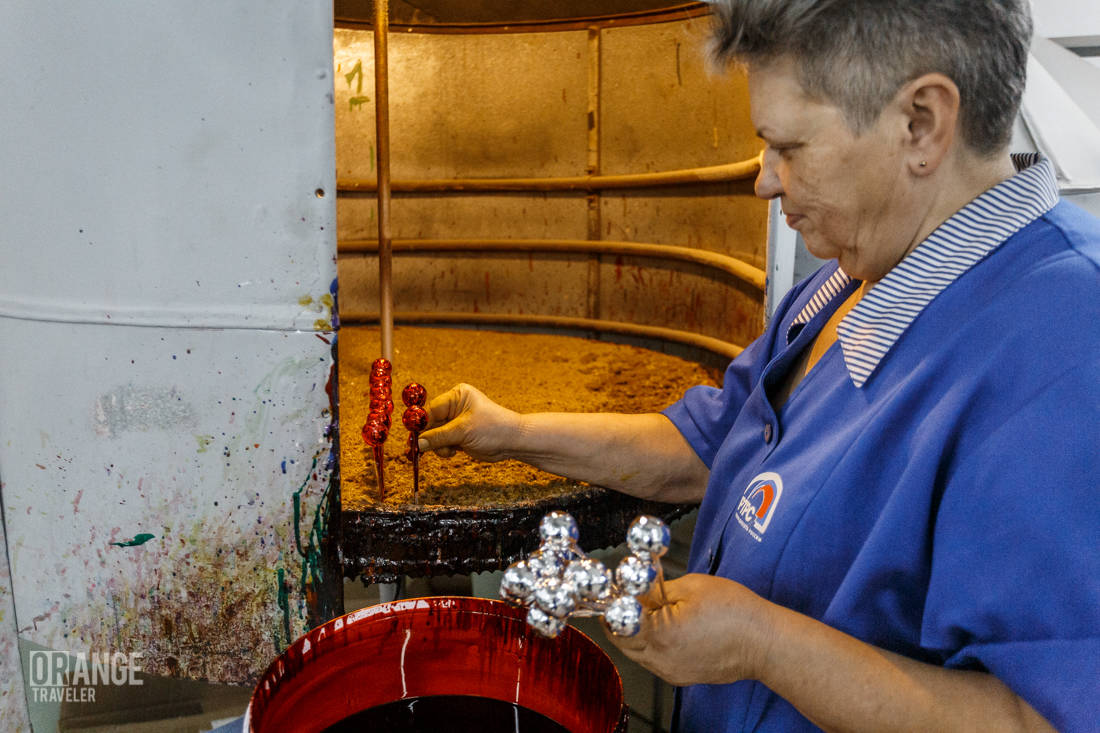
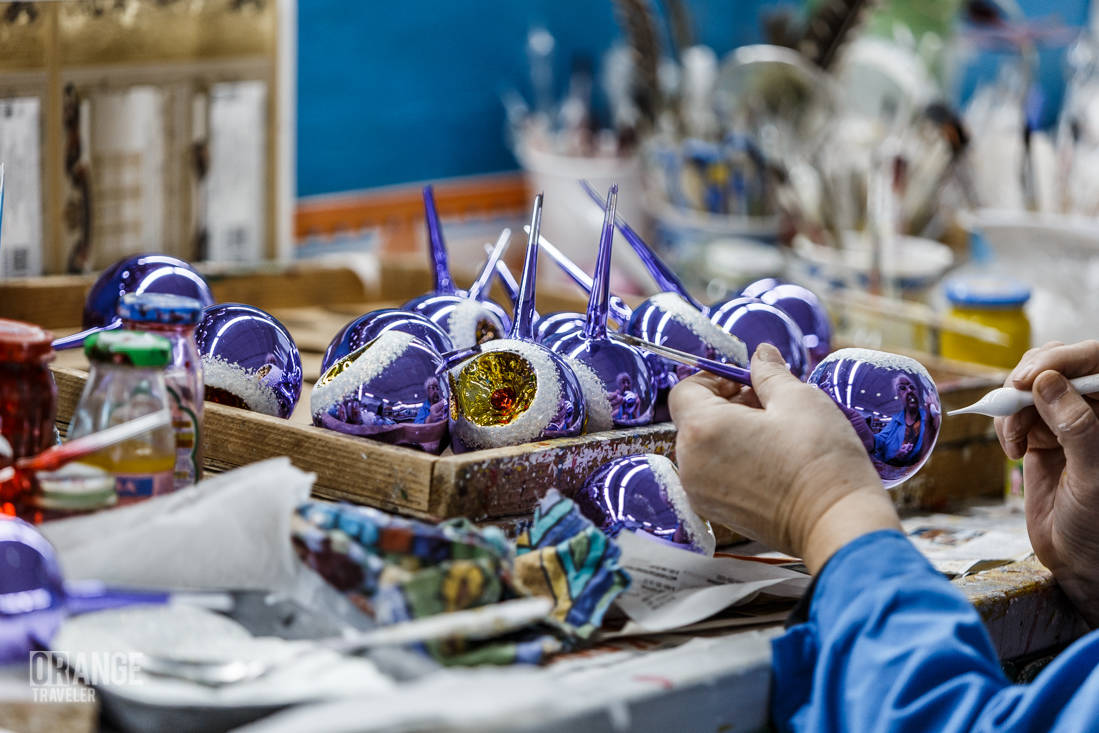
The whole process takes about an hour. Then the decorations are transferred to the painting workshop. The balls are painted by hand as well — only manual labour is allowed at the factory. The process is quite simple — the item is held by its “tendril” and dipped in paint for a few seconds. Then it is placed in the dryer. Right after drying the specialists check if there are any smudges. If everything is fine, the ornaments are moved along to the next process, to the area where they will be artistically painted.





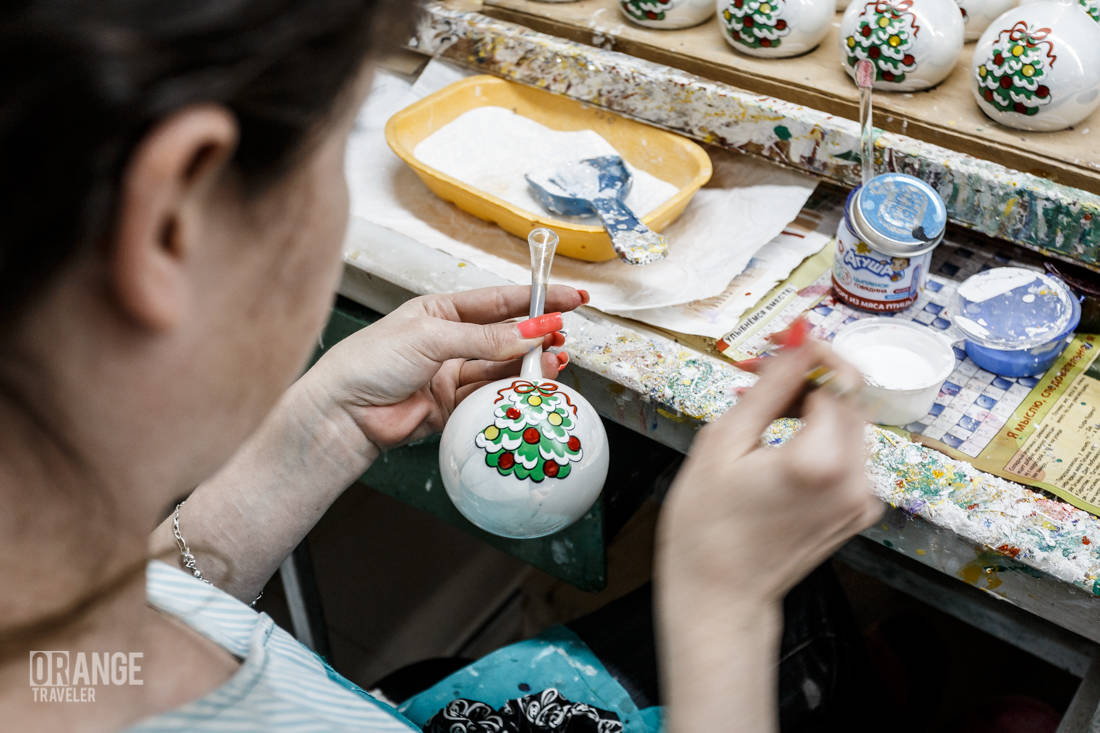
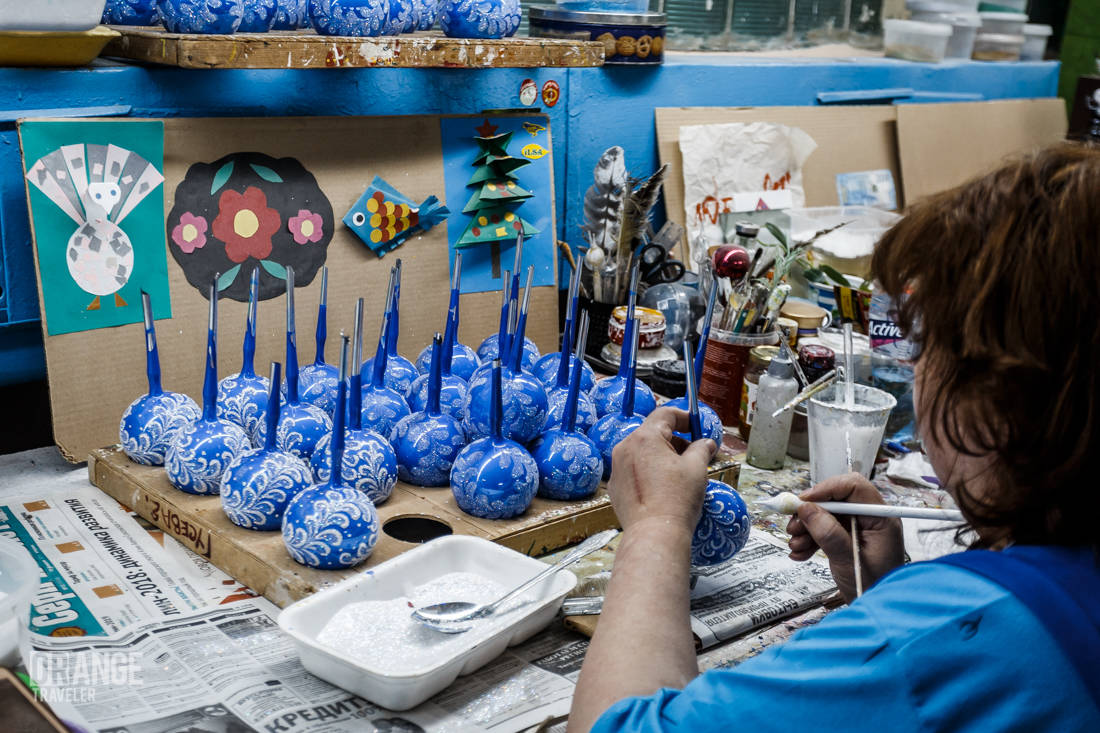
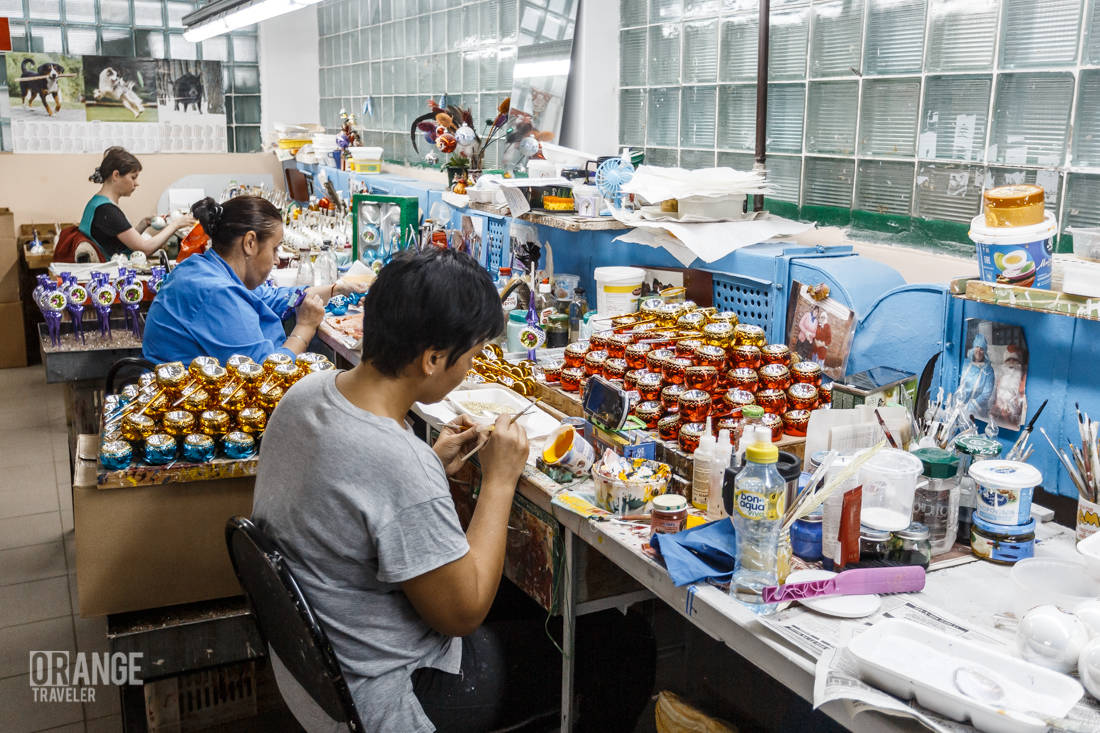
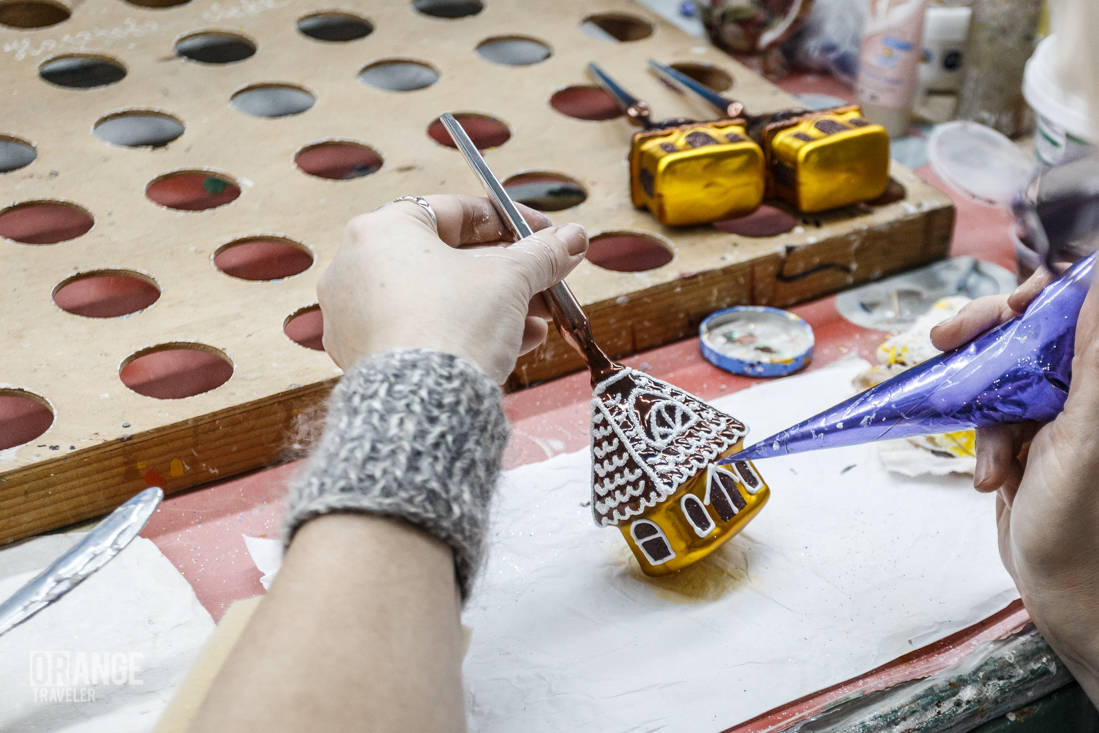
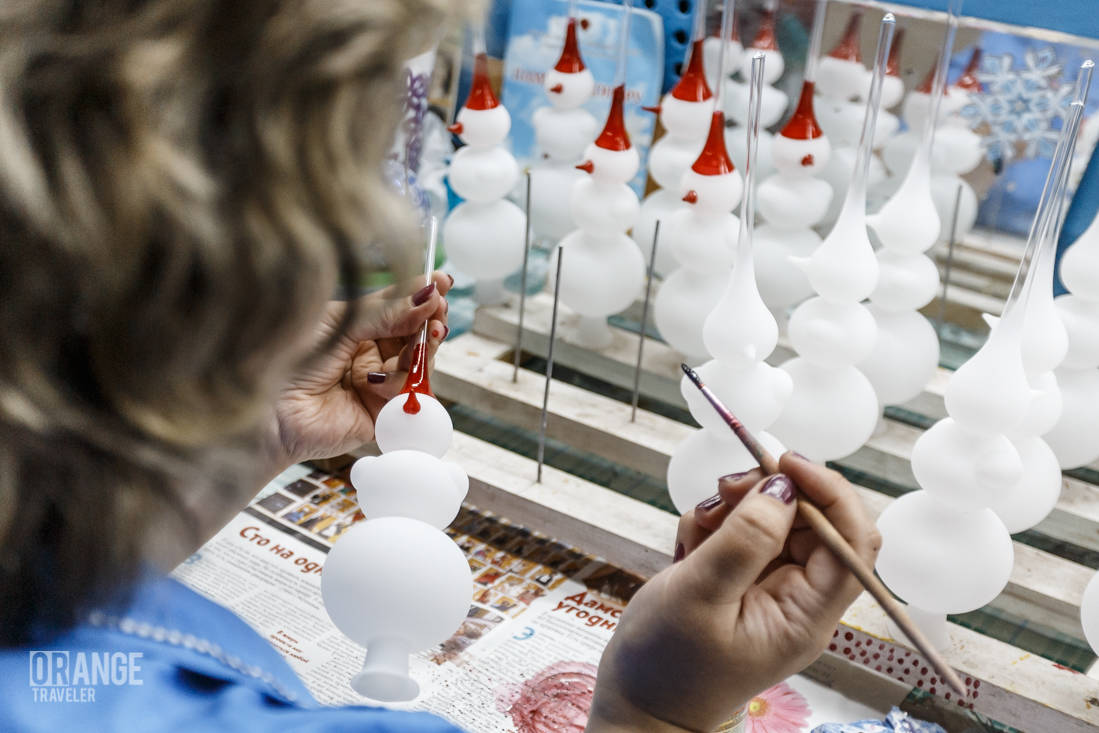
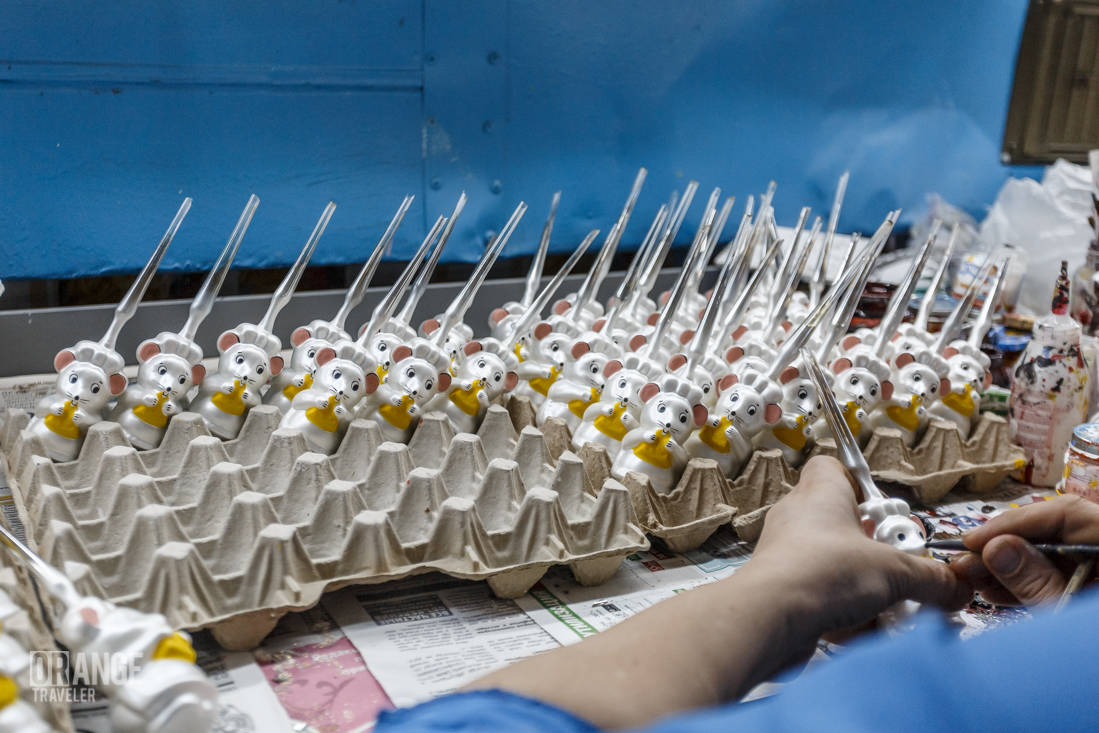
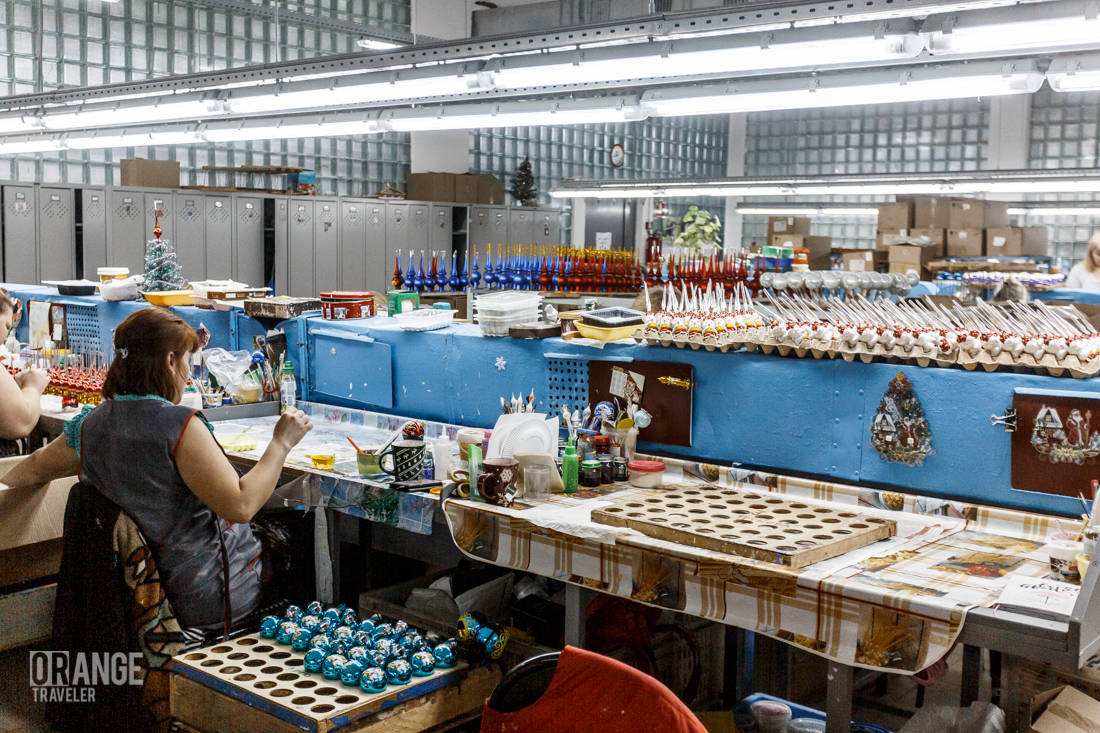
They are hand-painted with acrylic paints and brushes. There are about 40 people working in the decorating section. As is usual in any female team, it is either completely quiet in the room and everyone is busy doing their jobs, or someone is chatting about kids and household chores while generously applying glitter to the toys. Decorating a sphere is different from painting a flat surface, it has a great number of nuances.

The shapes should be drawn within the axis, so they don’t smudge across the sphere. The balls and the figures are decorated in several steps — while the paint is left to dry on one of the items, the artist will work on another one. There are loads of ornaments lying, hanging and standing around every artist. You won’t find two identical figures: the mice do resemble each other, but they are more like sisters; all the corn seems to be from one batch; however, every ear has a unique stroke mark.


The most complicated task in this department is decorating a sphere with a landscape. The artists paint Russian villages, churches, and flower patterns on a glass sphere with a diameter of 115 mm. It’s impossible to paint more than 5 of these of good quality per shift. That explains their prices. A landscape sphere is expensive. Only the highest-level professionals get to decorate figures for the collectable series such as “Four Seasons”, “The Turnip”, and “The Folks of the North”. The lead specialist decides who will paint “The Rat King” and who will be responsible for the simple patterns. After the ornaments are decorated, they are transferred to the packaging department, where their “tendrils” are cut off, clips are attached to them and they are placed into beautiful boxes.

Decorations with the new Chinese zodiac signs have reached a peak of popularity. Customers prefer figurines over balls. There is also high demand for retro ornaments — Puss in boots, bear on a tree, elephant on a ball — that are created from the original traditional shapes. Such ornaments are always the first ones to be sold out. “Yolochka” produces tens of thousands of zodiac decorations annually. While we are currently buying mice and rats of all breeds, the factory approved sketches of a bull long ago, and the production of zodiac signs for 2027 will start in January of 2026.

However, not all of the zodiac animals are popular. It turns out that snakes trigger a negative reaction among most customers. Those cute and smiley glass reptiles were purchased in smaller quantities than usual during the Year of the Snake. It was challenging during the Year of the Pig as well, as few customers wanted to “play dirty” with their gifts.
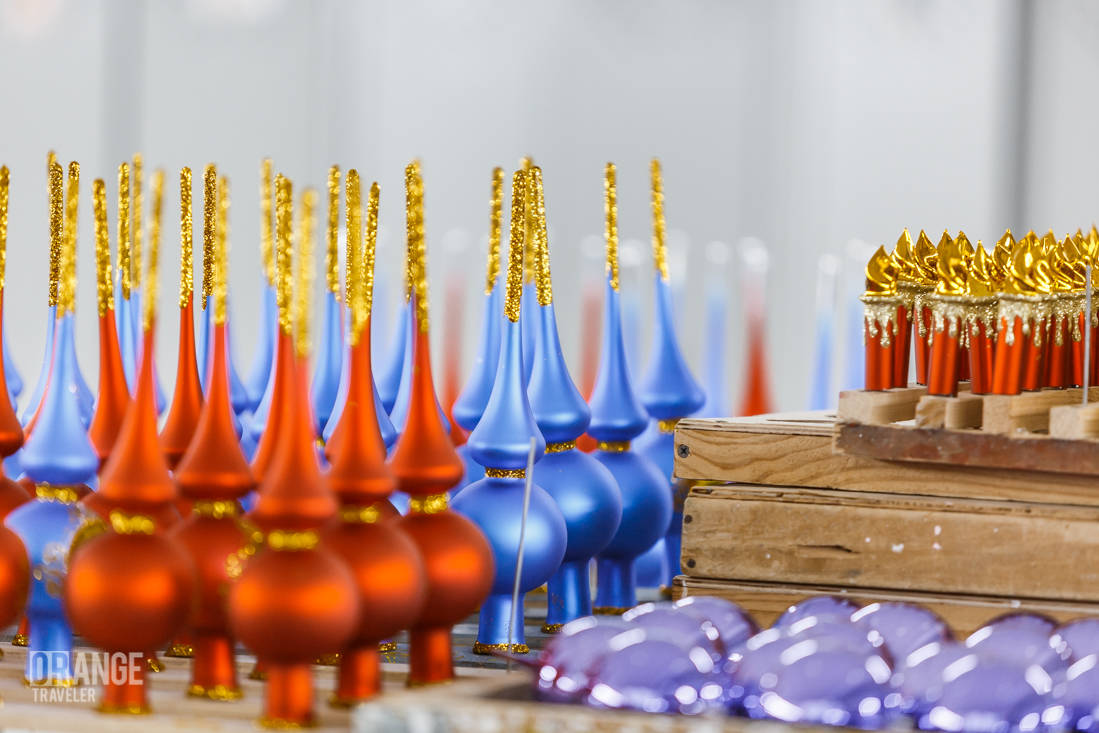



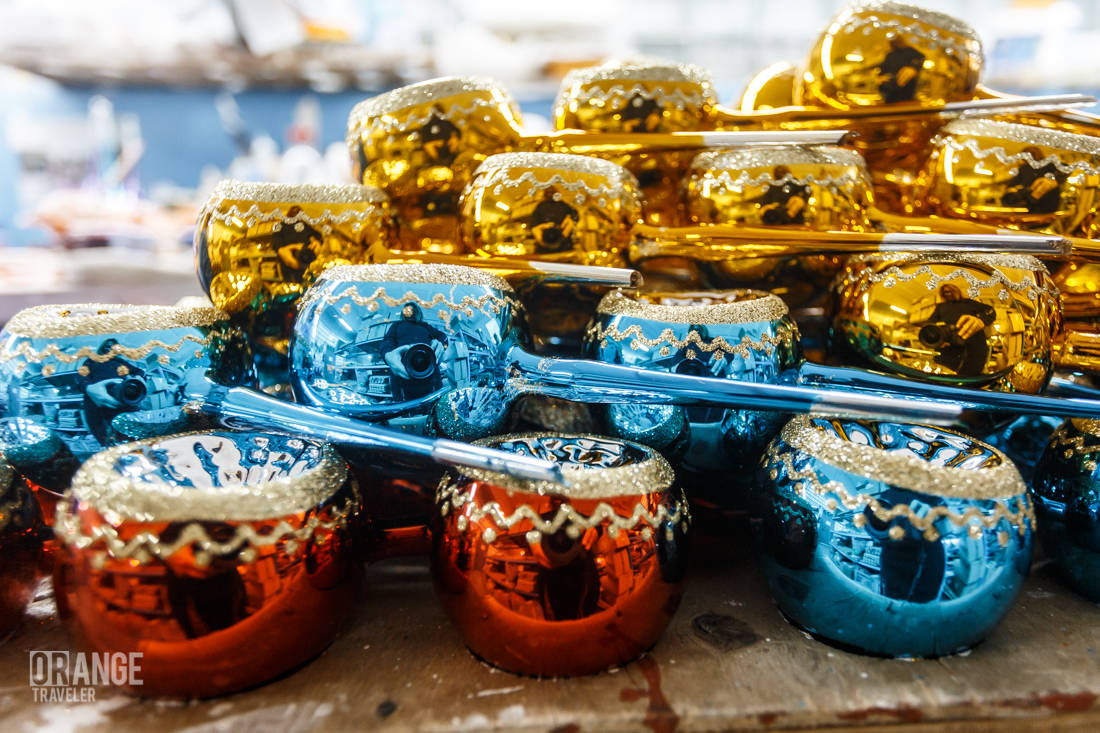





Ideally, every ornament has to be kept in an individual package, which is, obviously, rarely possible. So it is better to place them in small flat boxes and wrap them in paper. It is important to keep them in a dark place. If these rules are followed, the decorations will remain in perfect condition. The Christmas ornaments shouldn’t be exposed to bright light, in order to prevent the paint from losing its colour. In fact, blue shades are usually the first ones to lose their intensity, while the yellow and red ones last the longest.

It is easy to find out how Christmas decorations are created. All you have to do is to book an excursion to the “Yolochka” factory in Vysokovsk, Klin district. The excursions are available in November and December. Booking is possible by phone (49624) 6-24-34 or via their website www.yolochka.ru

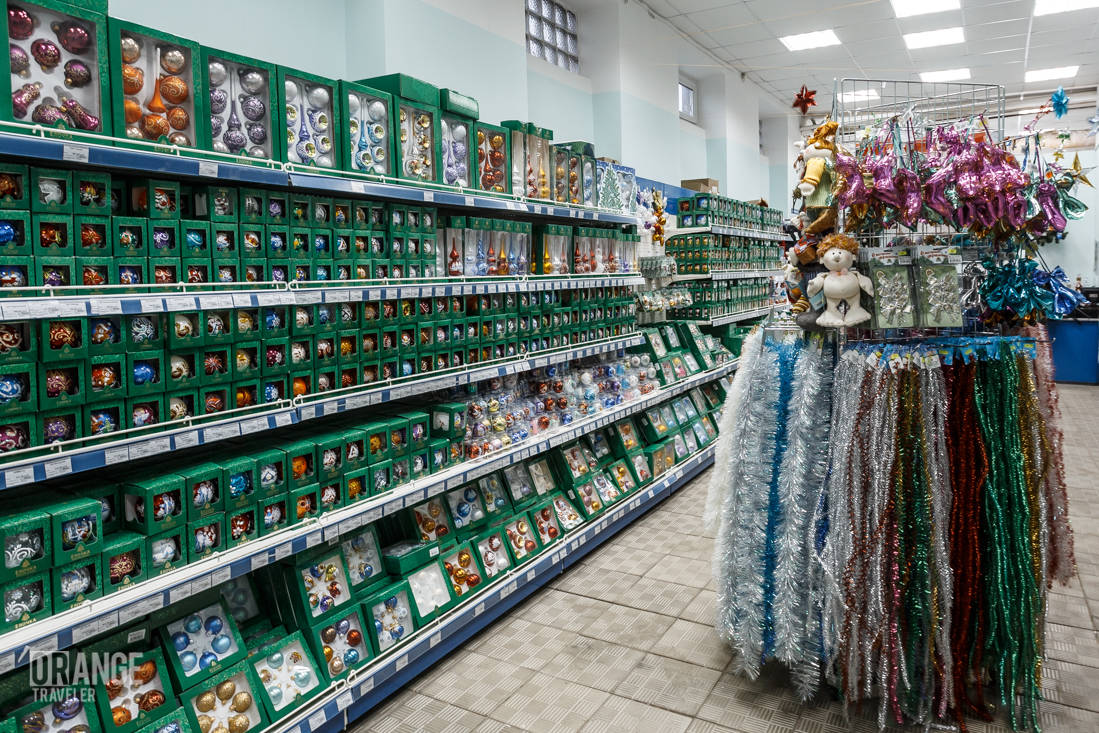
The visitors are usually combined into groups, but if there is no one else there on a particular day, individual tours are also possible. No one gets turned away. After the excursion, you can also join a Christmas ornament painting workshop at the Klinskoe Podvorye Museum. In 2026, painting a glass sphere costs 450 rubles; shaped ornaments start from 500 rubles. Not only can you keep the sphere that you painted, but you will also receive one decorated by professionals as a gift. After visiting “Yolochka”, head straight to the Christmas Ornament Museum “Klinskoe Podvorye” (“The Klin Compound”) in Klin to learn about the history of Christmas decorations. Don’t forget to buy some new ornaments; you will find the largest selection and the lowest prices in the stores near “Yolochka” and at the museum.

The most convenient way is by car, it is about 80 km along the Leningradskoye Shosse (Highway).

Special thanks to the Christmas decoration factory “Yolochka” and to Yan Shachikov, business manager, for organizing the report.
“The Four Seasons of Russia” project is supported by the Russian Geographical Society www.rgo.ru
A visit to the oldest Christmas tree decoration factory is recommended by the Russian Geographical Society.

Also read about Russian artisan crafts here:
The Pavlovo Posad Shawls
Gold Khokhloma:Travelling to Semyonov for 'curls' and 'row



 Travel reportage
Leave a comment