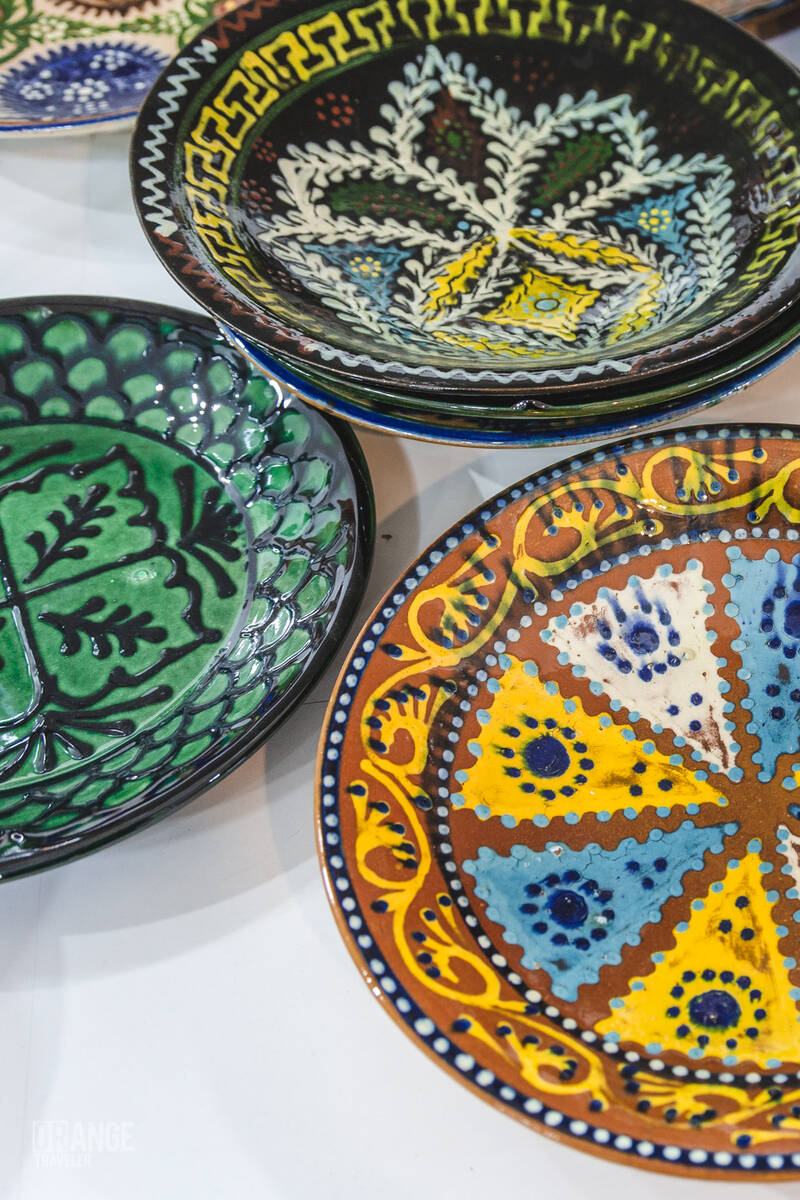
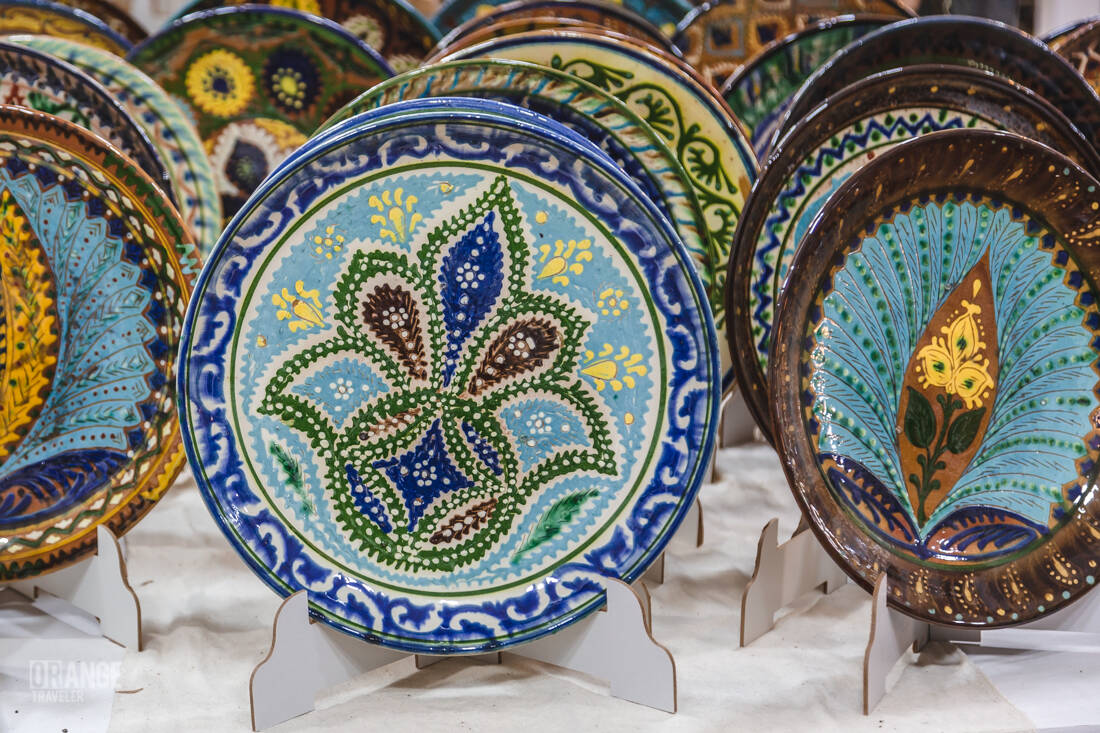
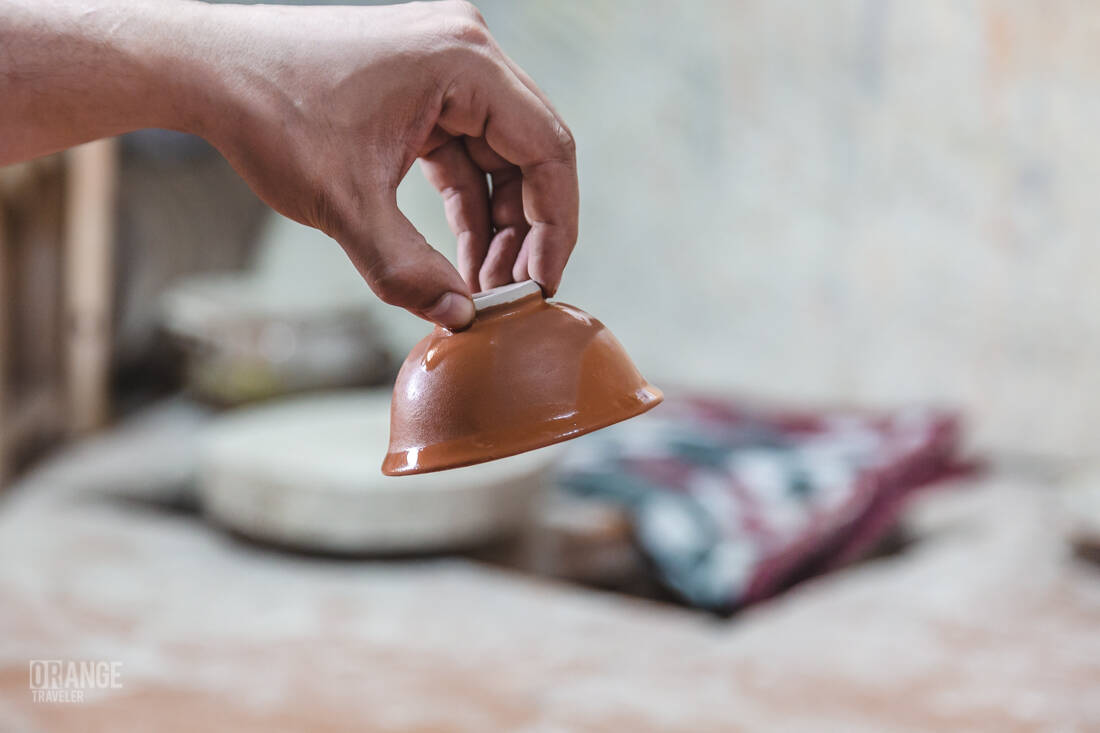
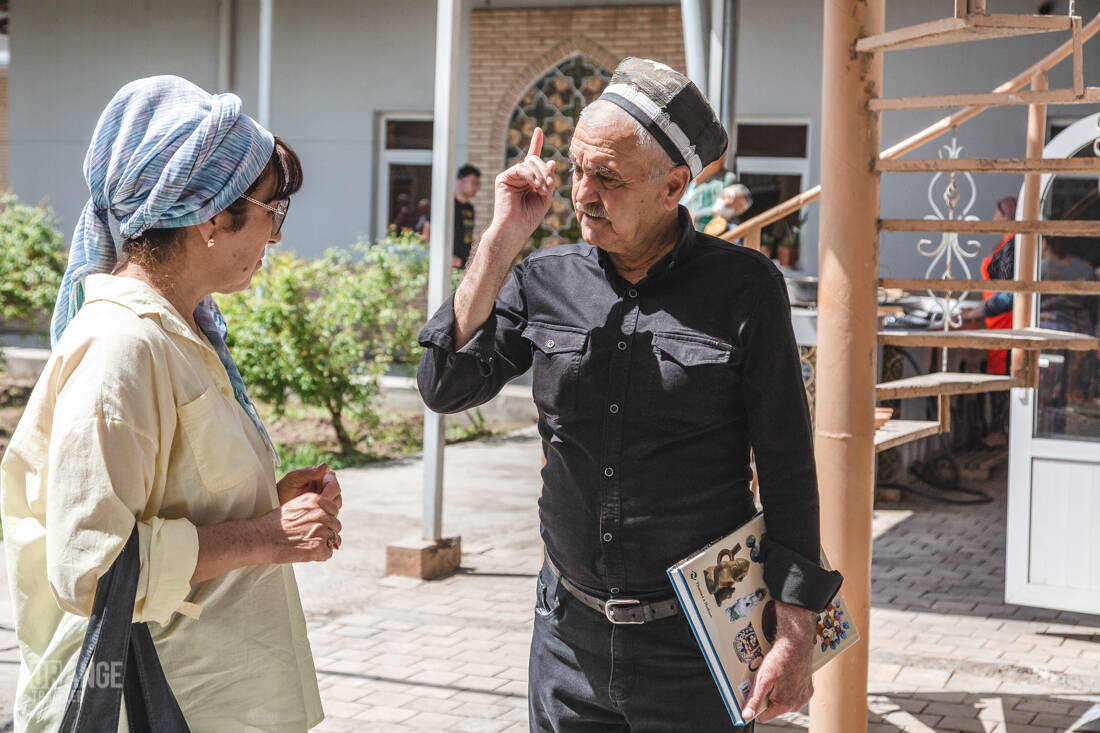
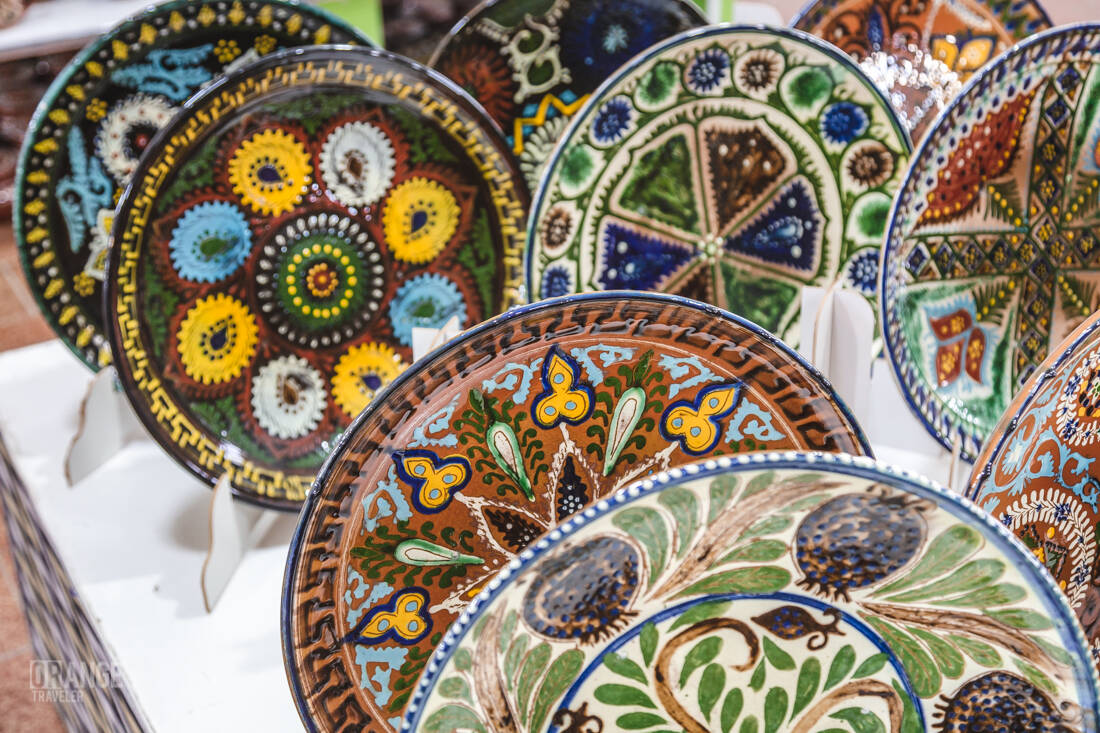
“I will show you the signs by which it is easy to tell that this is our handmade Gijduvan ceramics. Along the edges of our pieces, you can see drops of glaze. The pieces are fired upside down, which makes the colour run and dry, forming teardrop-like patterns. The three dots on the pieces are left by the three feet where the stand comes into contact. And the eight dots on the logo symbolise eight generations of potters.”
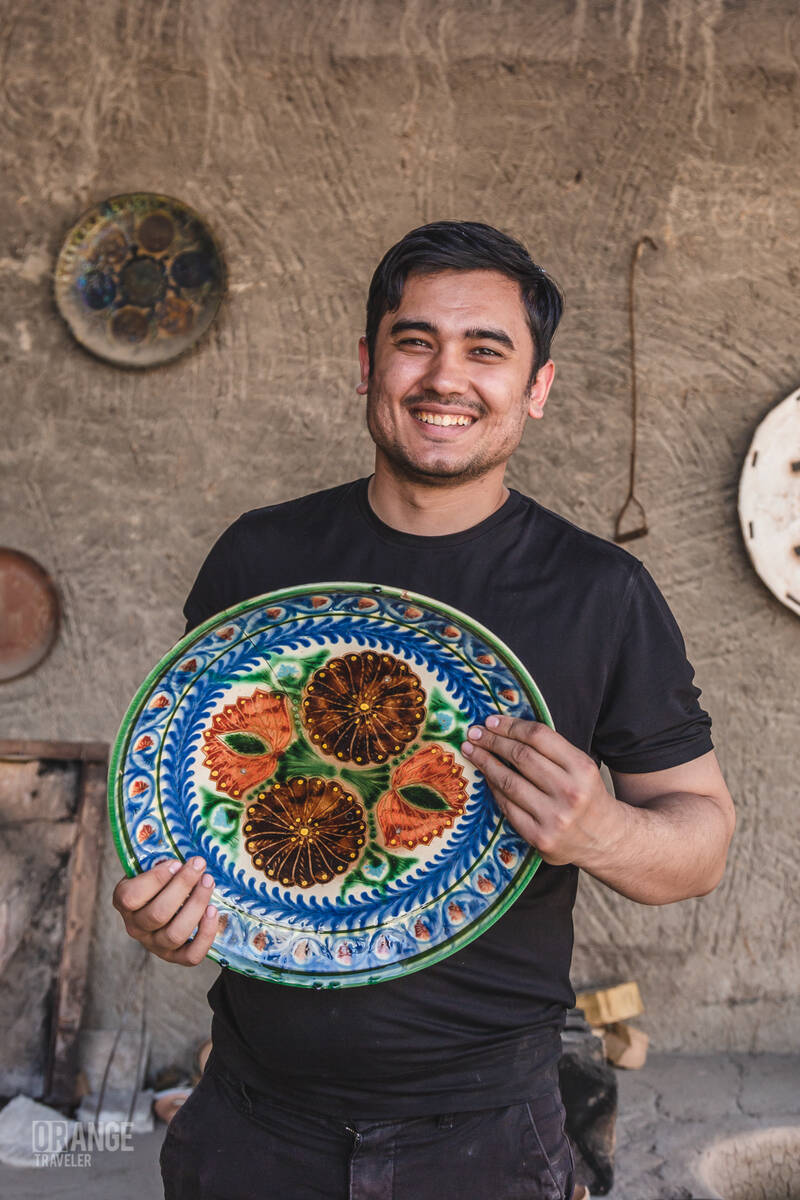
At the Narzullaev brothers’ workshop, guides welcome visitors and give detailed accounts of the history and process in many of the world’s languages. After long years of oblivion during the Soviet era, when potters had to work in secret to preserve and pass on their traditions, the pottery workshop is now enjoying its glory days.
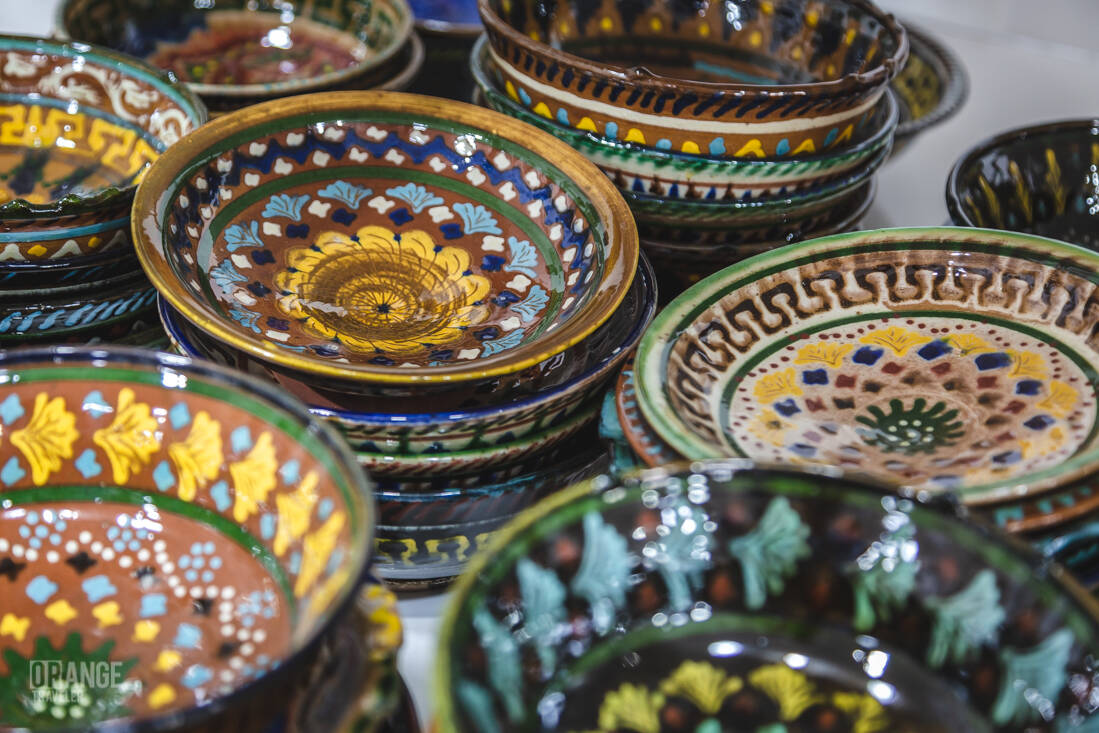
The history of local ceramic traditions is lost somewhere in the era of the Great Silk Road: it is around 2,000 years old. The Gijduvan school itself is more than three centuries old, and one family has been responsible for it all this time. Today, the craft is carried on by the eighth generation. Each master, from one generation to the next, added something new of his own; the ornaments became more intricate, but the technique remained the same. Yet of Uzbekistan’s five principal ceramic schools, the Gijduvan one is easy to recognise by its greenish-brown ornaments and thick layer of glaze.
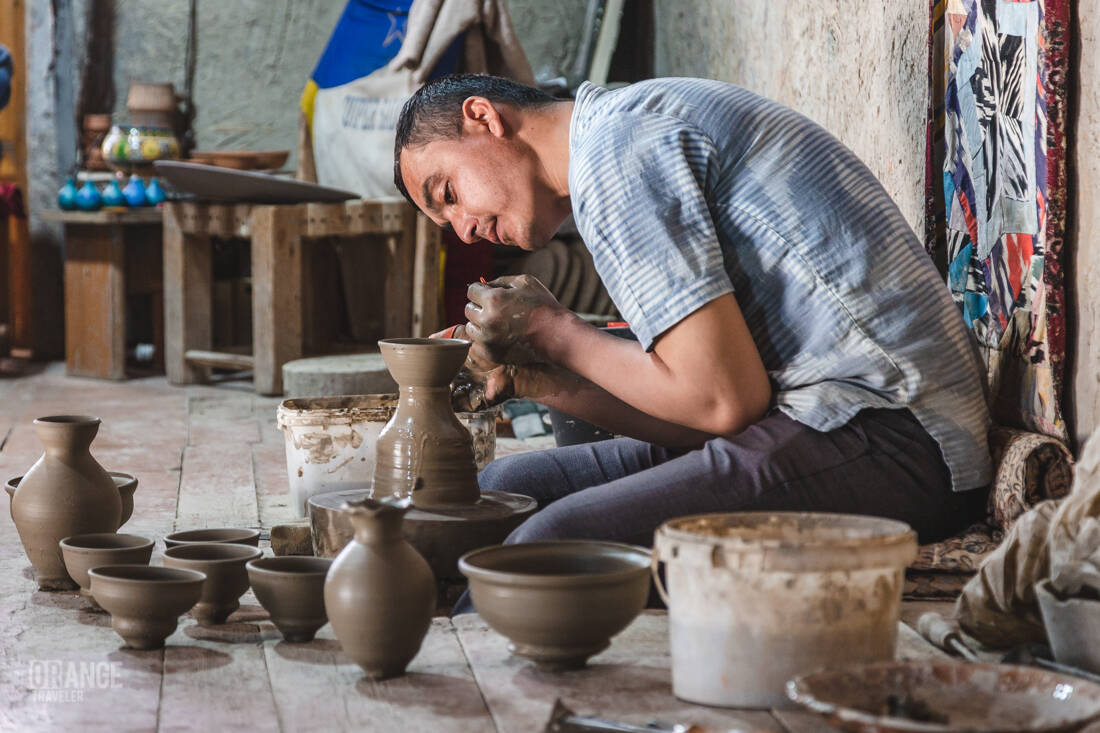
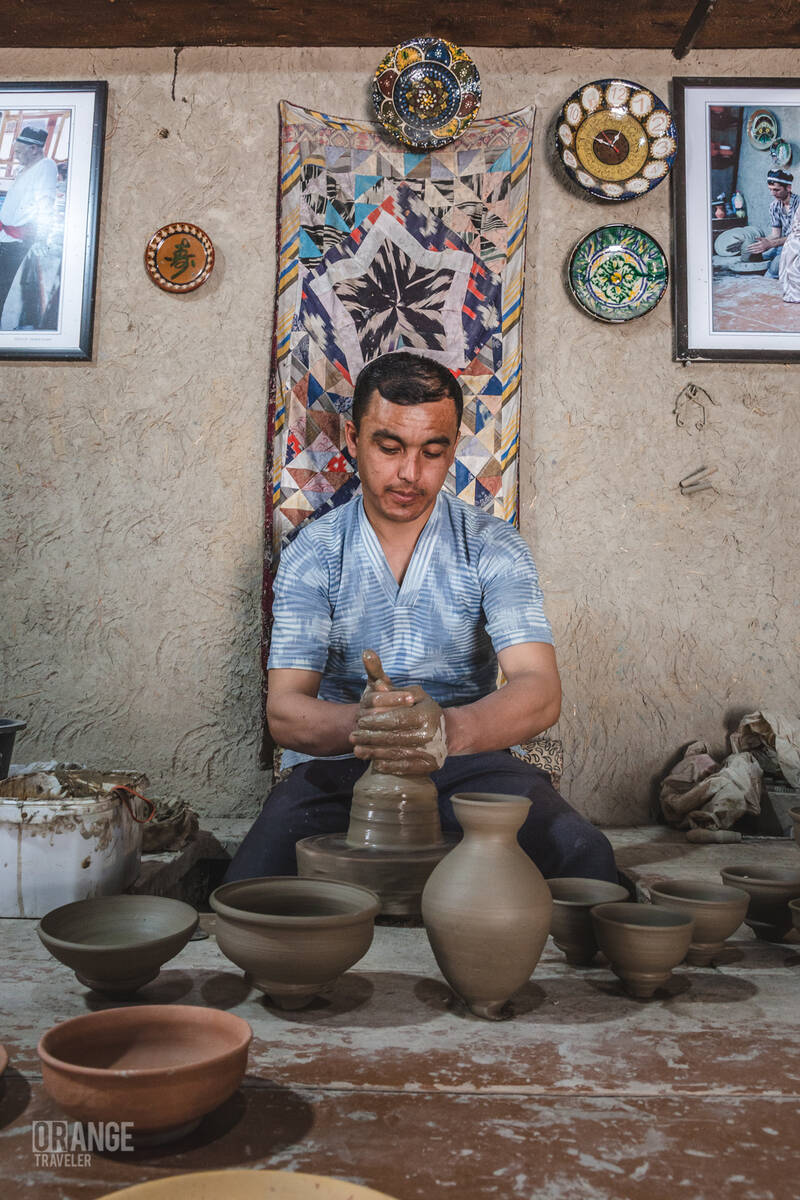
Behind seemingly simple pieces—plates and bowls—lies a complicated technological process. It all begins with a complex clay blend: local clay, taken from a depth of two metres, is mixed with 20 per cent river clay to make it more pliable. Everything is done by hand: the clay is ground down and mixed with water. Then, about ten days later, reed down is added to give the mixture strength. Only after that does the clay reach the master working at the potter’s wheel.
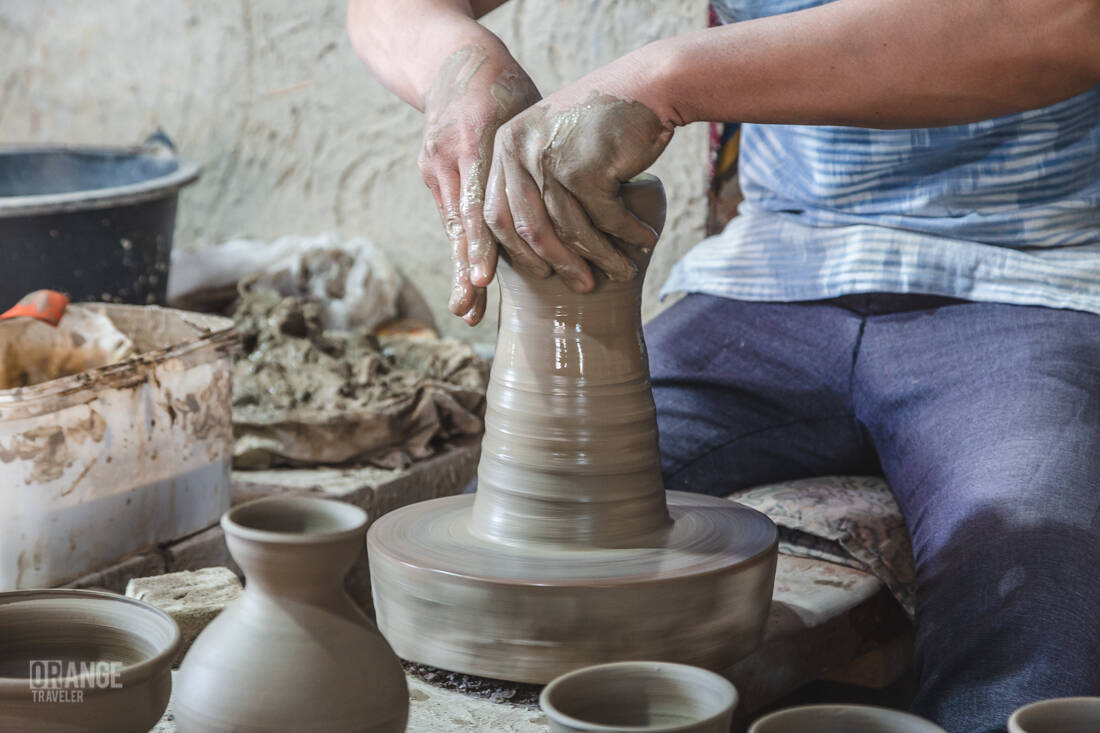
For the Gijduvan school, Nadir tells me, there are more than 80 forms of different pieces and over 150 ornaments. Today, eight masters work at the wheel, each of them knowing the whole process, from preparing the clay to firing the pieces. Curious about KPIs, I ask how many pieces one master can make in a day.
“Seventy, even eighty. But then, the next day, he has the complicated task of turning the foot. He simply will not physically have time to finish that many pieces, because the forms may dry out completely. On average, they make about 25, 30 at most, so that the next day there is enough time to prepare everything for painting.”
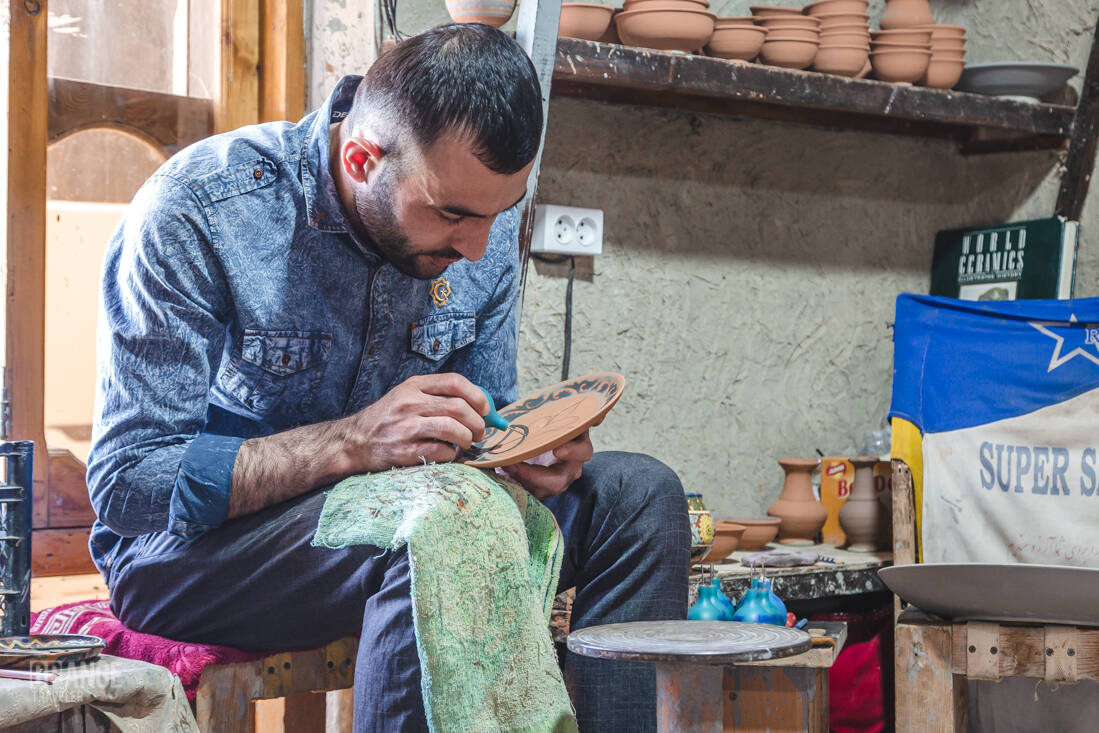
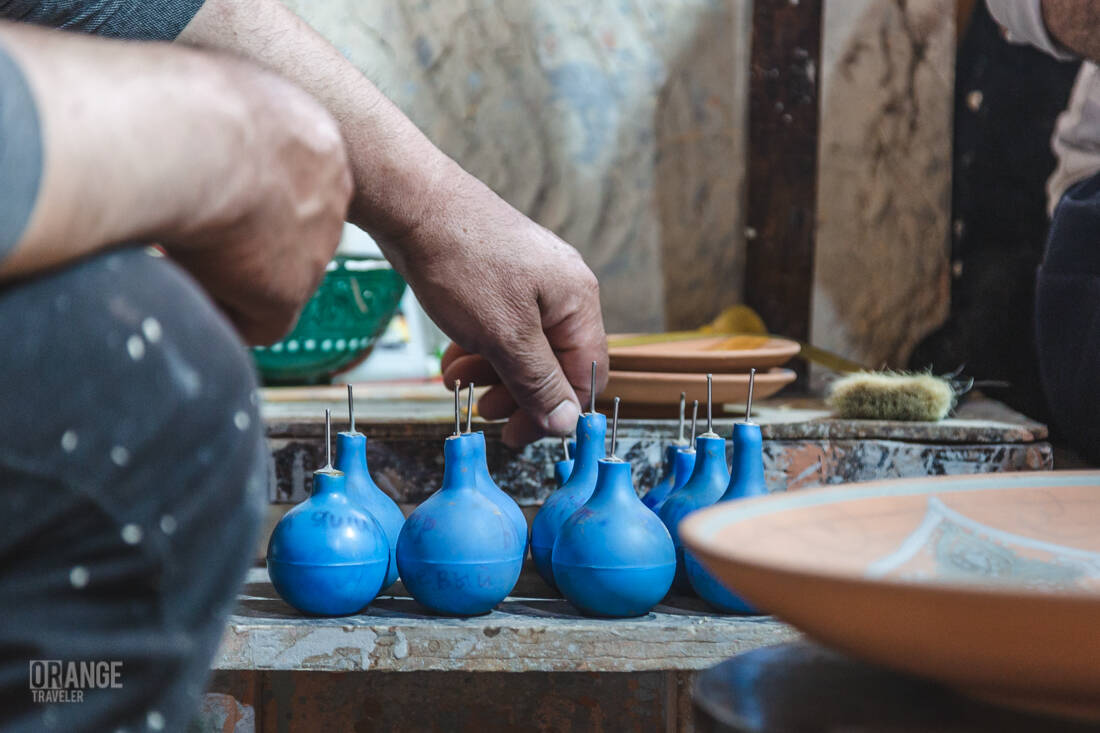
The workshop has no love for new technology. They use traditional potter’s wheels, firewood for firing, and a she-donkey turns the millstones where the glaze is mixed. A freshly shaped piece dries for a day at room temperature; then it is turned over and the excess parts are removed. Two days later, the form is covered with a base colour made from a complex mixture of red, yellow and even white clays, brought from other regions of Uzbekistan, and metal oxides: iron for brown, copper for green and cobalt for blue. Only then are the ornaments applied to plates and cups with special paint-filled pipettes.
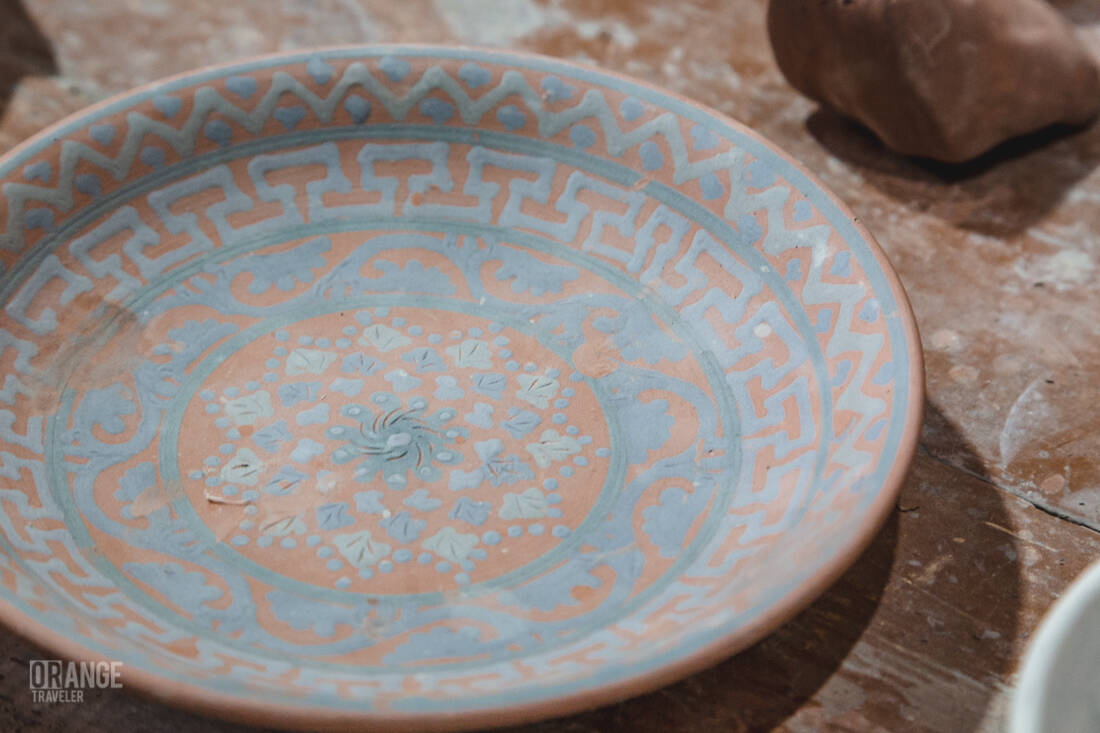
Most of the ornaments also come from ancient times, when entirely different travellers and caravans met along the Great Silk Road. Among the patterns are the Chinese sun, the Islamic islimi, the Greek meander and the Indian snake. Once the ornament has been applied, the front of the piece is covered with glaze; nothing is applied to the back, so that water can evaporate more quickly during firing. Partly thanks to this technique, Gijduvan ceramics can be washed in a dishwasher and used in a microwave oven.
Ancient Uzbek ceramics were always fired only once. In Gijduvan, they follow this tradition—the quality of the clay makes it possible. In the next small room, I saw enormous stone millstones.
“This is where we make the glaze.”
I had no idea that the process looked even more like a recipe from a book of wizards. I would have loved to know how the ancestors of today’s potters ever thought of such a thing. But I won’t get ahead of myself.
“The main component of our glaze comes from burning the plant climacoptera. And we do this only once a year—in September or October, when it is in flower. At this time of year, the plant has pink leaves. All the masters go out into the desert, dig a large pit, fill it with saxaul and burn it there. The plant sap turns into resin, drips onto the ash and mixes with it, forming this kind of charcoal. We then burn that as well, at a temperature of 1,400°C, in special furnaces.
“After firing, it turns into a crystal like this.”
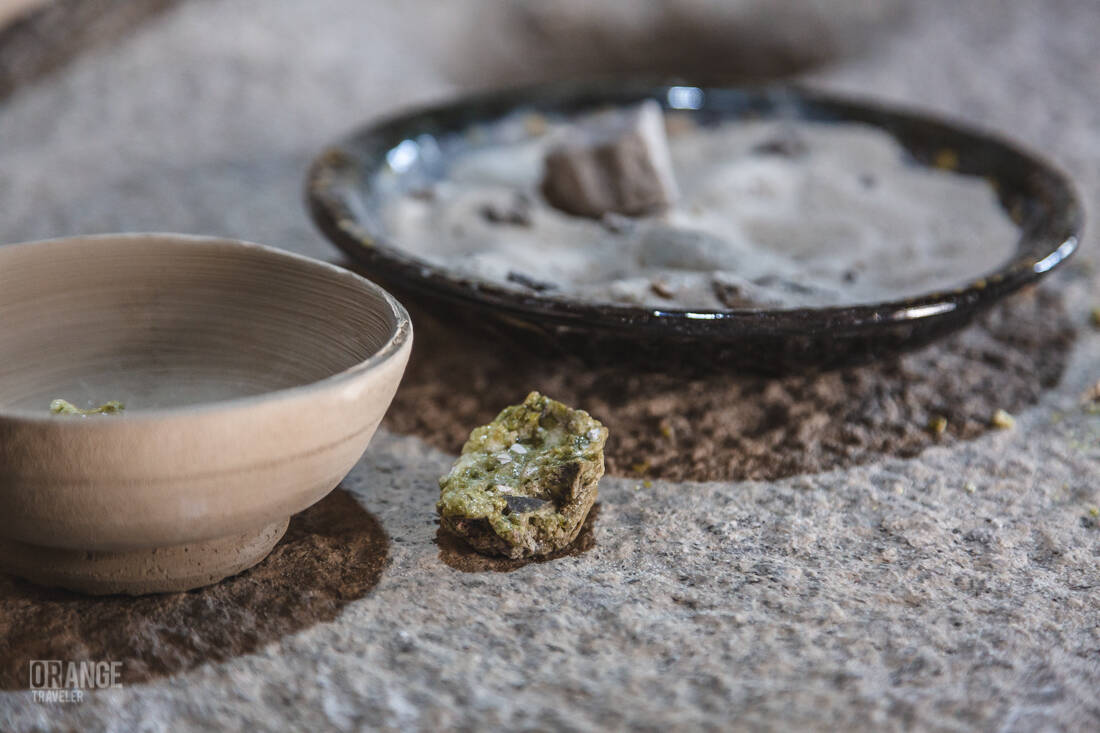
I picked up a small stone and turned it over in my hands, still unable to believe the complexity of such “potion-brewing”.
“How many flowers do you have to burn to stock up for the whole year?” I asked, spellbound.
“We gather about 3–4 tonnes of plants. From 100 kilograms, at most 10 per cent comes out.”
Seeing my surprise, the guide added:
“This glaze-making process was invented by someone long before our family took up the ceramic craft. So, we throw these glaze crystals beneath the millstones, add white kaolin clay—which we bring from Tashkent—fired glass, quartz sand and wheat flour. Like the reed down, the flour binds the ingredients and the water.”
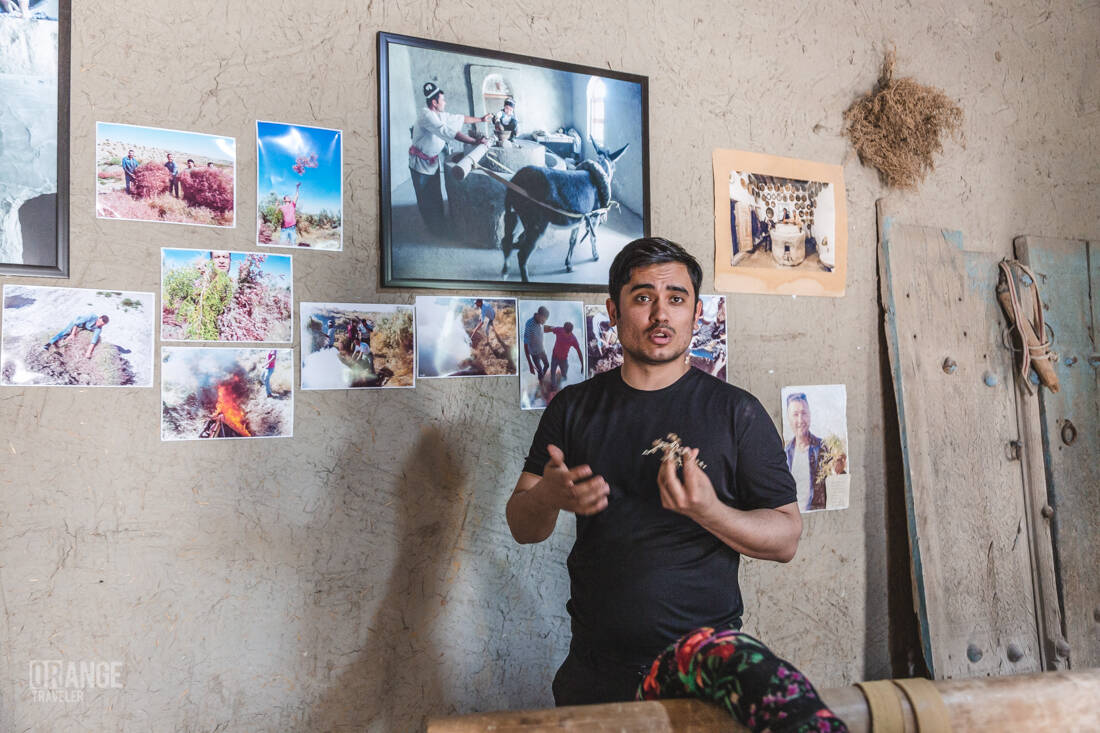
All the components are mixed for eight hours. Our Gulchatay turns the millstones for eight hours, with a break for lunch. In one day, she makes 80 kilograms of glaze for us, enough for one month. That is why she works here on schedule, once a month. The rest of the time, she receives guests and eats four times a day,” the guide reported.
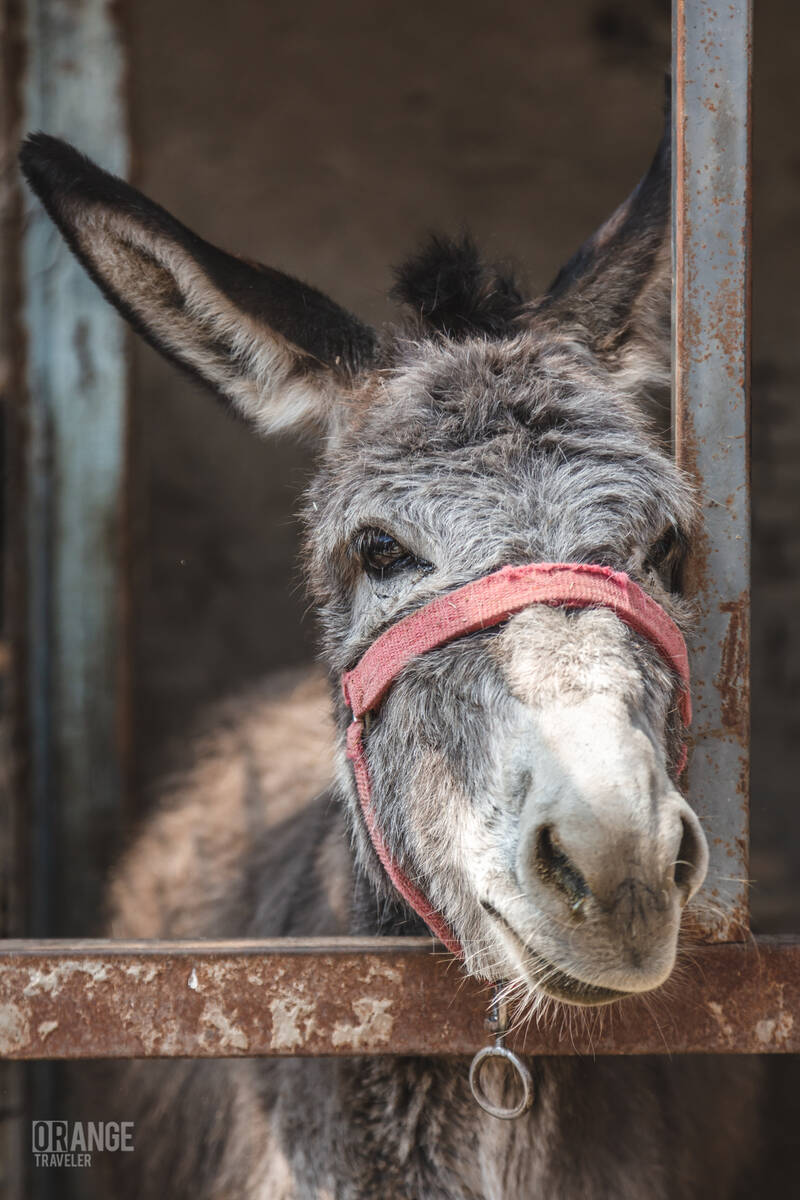
Gulchatay was standing in a pen nearby and demanding attention. Well-fed and cheerful, she nodded her head happily and pushed her muzzle forward to be stroked. Nearby, rams with impressive fat tails on their backsides were resting, while little goats scampered around.
“Come, I’ll show you our kilns,” Nadir said, pulling me along.
Before firing begins, one of the masters climbs inside the kiln and carefully places the glazed forms on stands.
“The kiln holds up to 150 pieces of different sizes at a time, so we fire it at most twice a month. That is more than enough.”
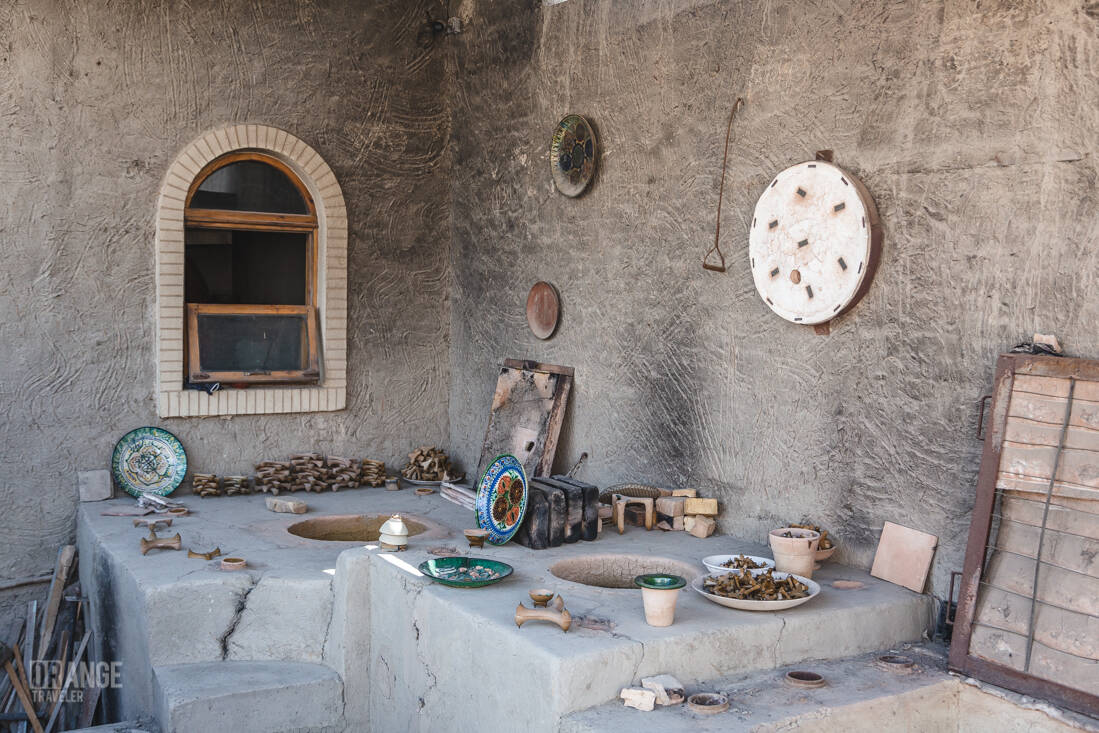
“We gradually heat the kiln over the course of one day, up to 1,050°C. At 500°C, the glaze begins to run; once the maximum temperature is reached, the ceramics begin to bake. We maintain that temperature for around 2–3 hours, then stop the firing. The cooling process is gradual too. In summer, it takes up to five days; in winter, up to two. If the pieces are taken out too early, they may crack.”
“Do they crack during firing as well?” I asked.
“No. If an incompletely dried form is put into the kiln, cracks may appear. If there is air left inside the clay, the ceramics will split. Sometimes a master misses something too—the human factor is always there.”
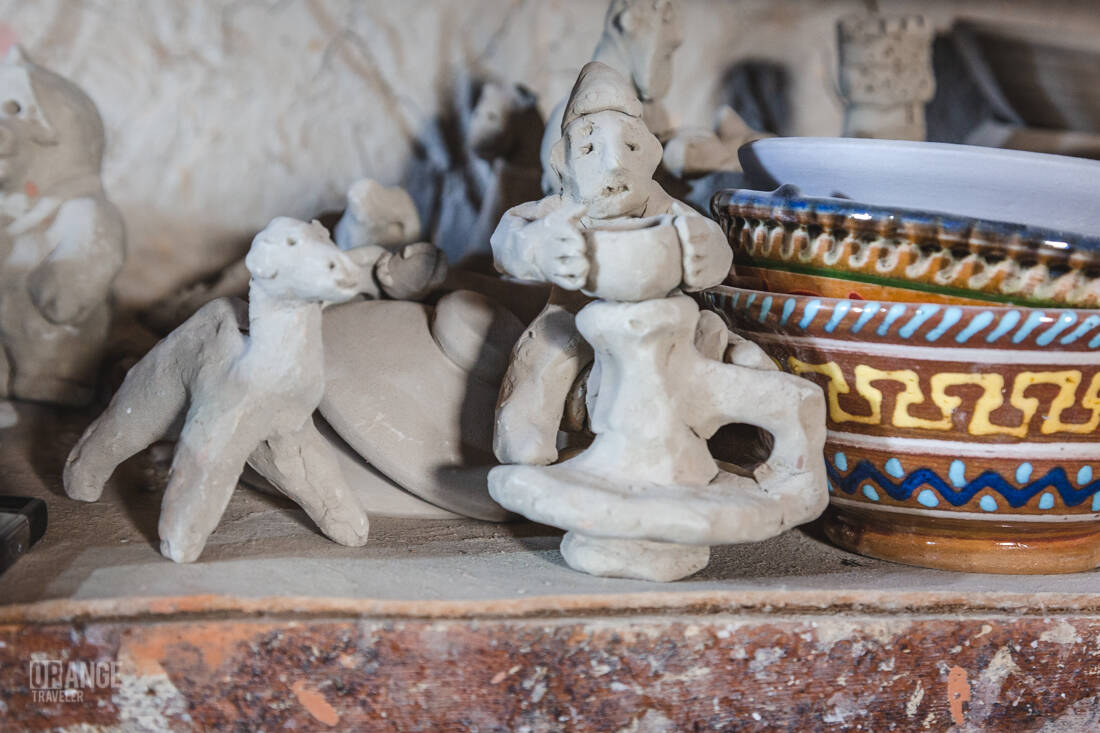
A new group of interested visitors was already approaching the kilns, and through a small room with photographs and old samples, we reached the shop. I badly needed plates and serving dishes, cups and bowls painted with ancient ornaments, glazed with a glaze made from desert flowers and pulled through the millstones by Gulchatay the donkey. The surprising thing was that the ceramics chose me themselves: my hands kept reaching for a serving dish or a bowl from the different shelves.
Gijduvan is a little under an hour’s drive from Bukhara. It is easy to get there without a car as well: excursions take visitors to the workshop.

My thanks to Timur Way and, personally, Yuliana Bozhko for organising an unforgettable journey through Uzbekistan. The company’s website features engaging tours accompanied by professional licensed guides.
Read more about Uzbekistan:
Samarkand: In the Name of Amir Timur
Uzbekistan: Questions and Answers
Khiva: An Ancient City of Uzbekistan
Bukhara: Twenty Cubits of Pearl Adras
Samarkand Carpets
The Livestock Market in Urgench



 Travel reportage
Leave a comment